

Anthony Bourdain Created A Gourmet Chocolate Bar - Here's What Happened To It

Anthony Bourdain was a great chef and connoisseur of equally great food, but he wasn't typically known for desserts, for good reason. Bourdain himself didn't typically like dessert; as he once told Publishers' Weekly, "if I had to lose one course for the rest of my life it would be dessert." But that didn't stop him from co-creating a chocolate bar with his friend, chef Eric Ripert of the restaurant Le Bernardin.
The duo partnered with master chocolatier Christopher Curtin of Éclat Chocolate to produce the Good & Evil bar, which launched in 2012. It was a large bar of 72% dark chocolate (the "good" in the name, supposedly representing Ripert's personality) studded with cacao nibs (the "evil" was of course Bourdain's contribution).
The bar cost a whopping $18, nearly $26 in today's money, but it was a viral and critical hit. Bourdain and Ripert relaunched Good & Evil in 2016 as a Williams Sonoma exclusive for $12.95 ($17.85 in 2026 dollars). They followed that up in 2017 with Salt & Sin, another 72% dark Williams Sonoma exclusive with sea salt, orange, fennel, and spices. However, upon Bourdain's untimely death in 2018, Curtin announced that both bars would be discontinued out of respect for his memory.
What did Anthony Bourdain's chocolate bars taste like?
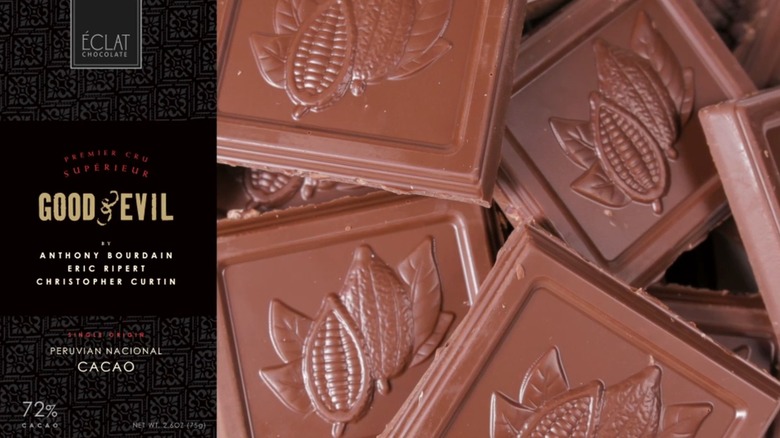
The most important part of the flavor of these chocolates was, of course, the cocoa beans. Bourdain and Ripert specifically chose an ultra-rare, nearly extinct species from Peru called Pure Nacional. Bourdain documented the luxury chocolate industry's effects on Peruvian farmers in an episode of "Parts Unknown," including the sourcing of the beans for his bars, which were necessary for their complex flavor.
According to a 2012 review in the Philadelphia Inquirer, the Good & Evil bar had to be savored to properly experience the flavor journey. It began with subtle notes of fruitiness and woodsy nuts, paving the way for bold and alluring dark cherry. Overall, it was a rich experience, and unusually creamy for dark chocolate; smooth and unsweet but without any bitterness. The review called it astonishing.
The Salt & Sin sequel was also well-reviewed. Fans enjoyed the unusual combination of dark chocolate and fennel, with their strange and exciting savoriness delicately balanced by sweet orange, like a high-end take on the flavors of a chocolate orange.
Bourdain's unintended chocolate legacy
It's a bit ironic that Bourdain's line of chocolates was so successful, given that a project that arguably ignited his passions more fell through. In 2017, Bourdain was forced to cancel his plans for a Singapore-inspired NYC food hall due to leasing difficulties. He was well-known for loving the street food experience worldwide, especially in Southeast Asia, but his long-held dreams of replicating the experience in New York unfortunately remained just that.
However, the Good & Evil and Salt & Sin bars are at least a cherished memory of one of Bourdain's exceptions to his disdain for dessert. On rare occasions, he revealed in a 2016 Thrillist interview, he would end a meal with chocolate. "A little piece, I don't need a lot. But very, very rarely." Perhaps that was part of the inspiration to make his own chocolates the way he'd like them.
Consumers have a lot to consider when buying dark chocolate, and chocolate that's more than 70% dark (like Bourdain's bars) contains antioxidants that reduce inflammation and support both healthy circulation and blood pressure. So they didn't only taste good, they were good for you. For a time after being discontinued, they could be found online for astronomically high prices, but the resale market appears to have dried up, and these chocolates are now only a memory.