

Forget Vegetable Oil: Use This Fat To Season Your Cast-Iron Skillet
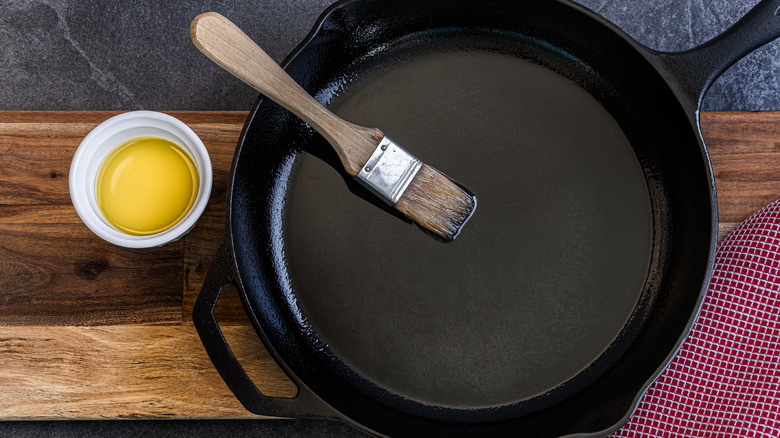
Cast-iron cookware is durable, awesome at retaining heat, and built to last. However, if you want your skillet to get better with age, you'll need to season it regularly to lend the surface a protective coating, maximize its non-stick capabilities, and prevent it from rusting. Vegetable oil is brilliant for seasoning cast iron, but there's another fat in town that adds flavor in addition to boosting its non-stick potential: Bacon grease.
Seasoning your cast-iron skillet with bacon fat creates a savory layer on the surface that's rich with umami flavor. Each time you cook in that same pan, the thin glaze of seasoning imparts its flavor into your food, lending it a moreish quality and inviting aroma. The other pro of using bacon grease is that it has a 325-degree Fahrenheit smoke point, which is almost as high as other fats like butter or coconut oil. While this isn't as high as vegetable oil, which has a smoke point of 400 degrees Fahrenheit, you can still get away with using bacon grease as long as you keep your oven at a medium-low temperature.
Having said that, bacon is cured with salt and sugar, which means the grease won't be free from residues that could burn. Straining the bacon grease first through a coffee filter can help to catch any of those sediments or impurities, but you will need to keep a watchful eye on your skillet while it's in the oven to make sure it doesn't get too smoky.
How to season a cast iron skillet with reserved bacon fat
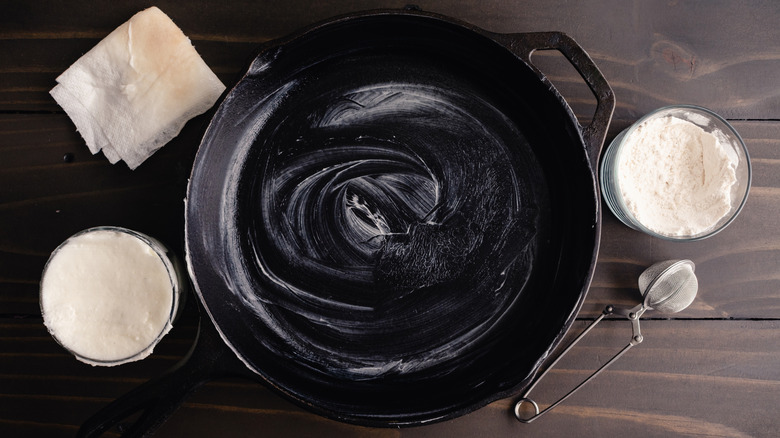
There is, of course, nothing to stop you from using vegetable oil to season your cast-iron skillet; it's convenient and quick. However, if you've cooked some bacon anyway and have saved the drippings for frying eggs or making bacon grease country gravy, you may as well make use of any leftovers and give your pan an extra layer of rich flavor.
You can season a cast-iron skillet with bacon fat in much the same way as you'd use vegetable oil. Simply rub a thin layer of the melted (and filtered) grease over the surface of the pan, making sure to cover it fully. Then pop it into a medium oven for 30 minutes. If you're seasoning a brand-new skillet, vegetable oil is a better bet because it's less likely to scorch (you should repeat this process two to three times to create a solid coating). However, if you're giving a well-used pan a quick refresh, you can do it once with bacon fat and repeat as necessary once the shine of the patina has worn off – you should re-season your cast-iron skillet once a month if you use it regularly.
Aside from bacon grease, other flavorful animal fats, such as lard and tallow, can be used to season cast iron. Moreover, as they don't go through a curing process, there are no residues present that could burn and turn bitter.