

Avoid This Mistake When Air-Frying Boiled Eggs

Air frying is one of the most unique ways to cook boiled eggs because it eliminates the need for saucepans and stovetops. Simply put your eggs straight into the basket, air fry until the center reaches your liking, and dump them into an ice bath to immediately halt any carryover cooking. Easy and breezy! However, there's one rookie mistake you should avoid when air-frying boiled eggs: Cranking up the temperature too high in a bid to cook them faster.
Air frying your eggs at a low temperature is always the best option because it allows them to cook more uniformly. Aim for 7-8 minutes at 280 degrees Fahrenheit for soft-boiled or 14-15 minutes for hard-boiled (as always, have a play around with the exact timings because each make and model of air fryer will produce different outcomes). While you might be tempted to turn the heat up to save time, you'll likely get uneven results and make it much trickier to remove your eggs at the perfect sweet spot. In the same way as a regular oven, air fryers cook from the outside in — a very high temperature will cause the whites to firm up too quickly before the yolk solidifies. The result? Rubbery huevos that have an unappetizing texture and powdery middle. If you like your eggs to have a jammy center, stick to a lower temperature and longer cook time to guarantee that they have a moreish consistency.
Cooking and storing a large batch of air-fried eggs
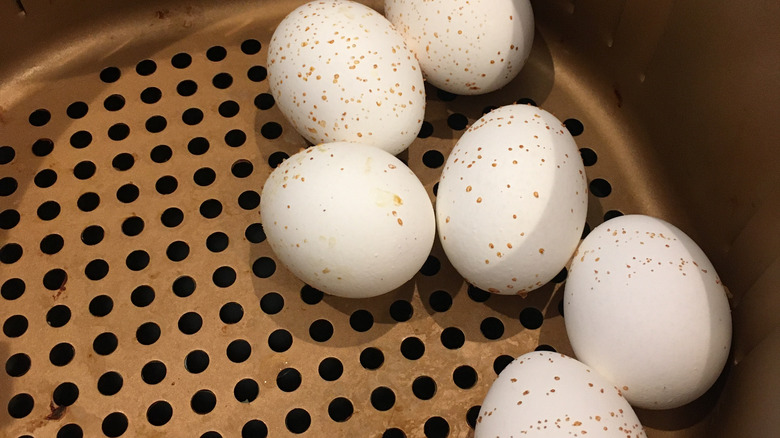
Air fryers are essentially smaller countertop versions of convection ovens where hot air circulates around the cavity. This movement encourages even heat distribution and helps food to brown up and crisp at a faster rate. Having said this, the hot air still needs to penetrate through an egg at a consistent rate to get the best results. Just as a cake will overcook on the outside and be runny in the center if you bake it at a temperature that's too high, the same can be said for air-frying boiled eggs.
The awesome thing about air frying huevos is that you can easily cook an abundance of them at once to stash in the fridge for later, saving you time and energy costs. Boiled eggs can be kept in the fridge for up to seven days, which means you can use them on salads, sandwiches, and more throughout the week (keeping their shells on drying them well will prolong your hard-boiled eggs' fridge life further) If you only need to make a couple of eggs, why not make use of the leftover space left to cook other breakfast items, like bacon or hash browns, at the same time?