

10 Vintage New Year's Eve Foods You Hardly See Anymore

The end of the year is a time for a lot of things: Reflection on the 12 months that have just gone by, a chance to discuss what you plan to do in the coming ones, and an opportunity to eat all of the delicious food you can get your hands on. Falling at the very end of the festive period, New Year's Eve foods often get overshadowed by the classics served during Thanksgiving and Christmas, and as a result, they often feel a bit more vague. Finger foods and platters are usually the name of the game these days for your New Year's Eve party, with the emphasis being on items that you can pick up and eat easily, usually while you're balancing a glass of champagne in the other hand.
It wasn't always this way, though. Throughout the years, New Year's Eve foods have changed considerably, and there have been some firm favorites throughout the years that have since faded from popularity. Dishes like Oysters Rockefeller, pickled herring, and Beef Wellington are now considered to be very vintage, while drinks like the Grasshopper and the Tom and Jerry are fairly uncommon cocktails at your NYE bash. Perhaps this year, though, you could reach into the past to check out these bygone delicacies.
Oysters Rockefeller
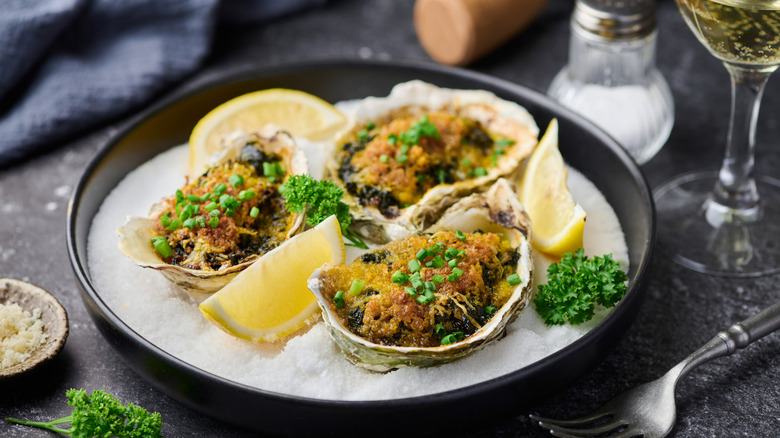
The days of casually serving up Oysters Rockefeller on New Year's Eve are perhaps gone forever (although we're sure there are some folks out there who still love whipping them up). Back in the day, though, this dish used to be far more popular for celebrations. Oysters Rockefeller were first invented in 1899, at Antoine's Restaurant in New Orleans, Louisiana, by its namesake, Antoine Alciatore. Its name came from the green appearance of the dish, which was said to mirror the color of money — and, of course, from John D. Rockefeller, who was at the time the classic example of enormous wealth.
It's probably no wonder, then, that Oysters Rockefeller came to be associated with New Year's Eve. The dish carries connotations of abundance and prosperity with it, and it's therefore the ideal recipe to make to toast the brand new year, and all of the fantastic things that are going to happen during it. Over time, though, Oysters Rockefeller began to feel stuffy and old-school, and it was gradually relegated to being a feature on super-fancy New Year's menus that felt out of the reach of a lot of folks. Gradually, the dish's popularity began to wane, and nowadays it's a rare sight.
Aspic molds
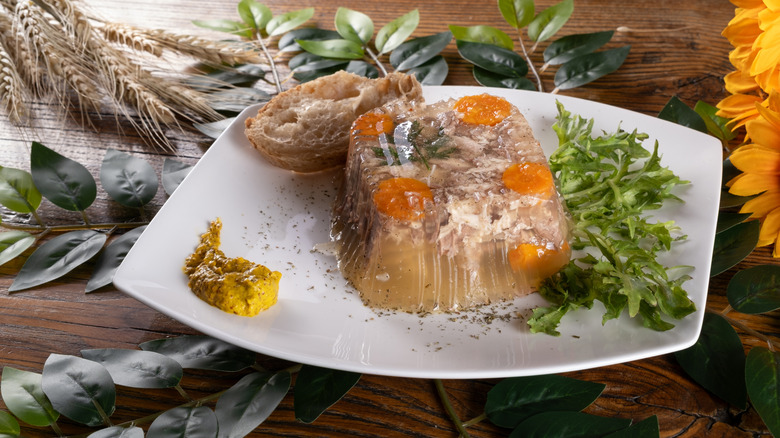
Is there anything as retro as an aspic mold? We don't think so, guys. The moulded meal, which typically consisted of a bunch of ingredients held together by gelatine in a cake or loaf shape, was all the rage back in mid-century America. Cooks were known to throw pretty much whatever they could find in them, and despite their kitschiness, they did come to represent a certain amount of abundance and glamor.
On the New Year's Eve front, though, a very specific type of aspic mold dish used to be popular: kholodets. This dish is a meat jelly that's traditionally popular with Ukrainian and Russian communities, and it dates all the way back to the 16th century. It's made by simmering meat and bones all day, and is typically served cold with spicy condiments like mustard and horseradish on the side. Kholodets and other aspic molds, however, are now pretty past their prime in terms of popularity, and the former is usually now found in more traditional settings. As for those extravagant molded dishes that contained anything under the sun, they're now long gone.
The Grasshopper cocktail
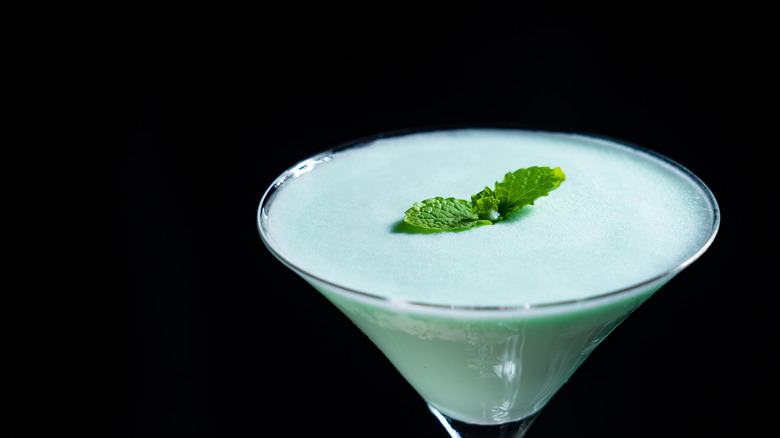
What better way to ring in the new year than with a glass of class? That's what you'll get if you're making a Grasshopper, a cocktail that's sadly seen less and less as time goes on. The Grasshopper is a particularly lurid drink and can be identified by its jade-green coloring (which, of course, is a similar shade to its titular insect). The Grasshopper cocktail appeared at the start of the 20th century, but it wasn't until the 1970s that it really took off, becoming a staple at cocktail parties.
When exactly it came to be associated with New Year's Eve is unclear, but both the Grasshopper and its variations have often been considered an ideal choice to see in the new calendar. We can see why: This is a cocktail that screams elegance, and while it's definitely a little bit old-school now, it speaks of a time when drinks were a little bit more fun. Unfortunately, though, nowadays people are more likely to share memories of their parents drinking Grasshoppers on New Year's Eve than actually making them themselves. We'd be surprised if you saw one this year, to be honest.
Baked ham and cloves
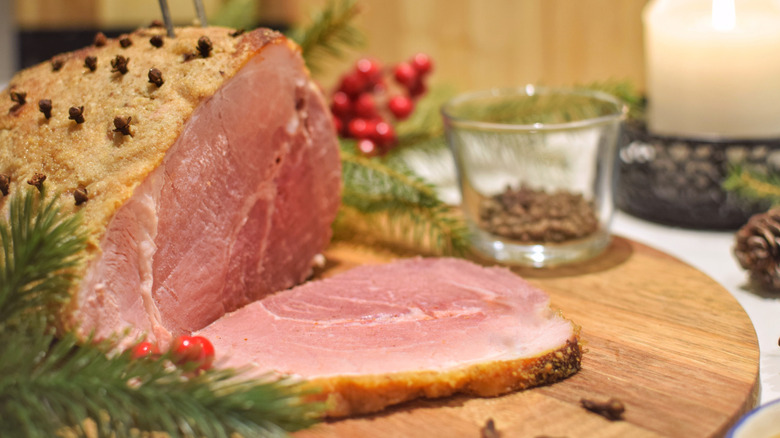
Nowadays, New Year's Eve food is generally portable, with a kind of serve-yourself vibe that lends itself well to parties. This wasn't always the case. New Year's Eve grub used to be a tad more formal, and was the result of hours of work and love ploughed into individual dishes. Such was the case with baked ham, an NYE staple that would appear on menus time and time again throughout the first half of the 20th century. This traditional New Year's food would frequently be studded with cloves, with this traditional pairing stemming back hundreds of years. Cloves were allegedly used to preserve the ham and mask any unpleasant flavors. Luckily, these days they generally just add delicious flavor.
Other folks skipped using cloves and instead opted for a regular glazed ham for their New Year's Eve food. However, as the years have passed, baked ham has become less common as a feature at NYE parties. This is probably because soirées held during that evening have drifted away from sit-down affairs and more towards easygoing gatherings where people stand around and mingle. It's much harder to eat a slice of glazed ham on your feet than grilled chicken skewers.
Oyster stew
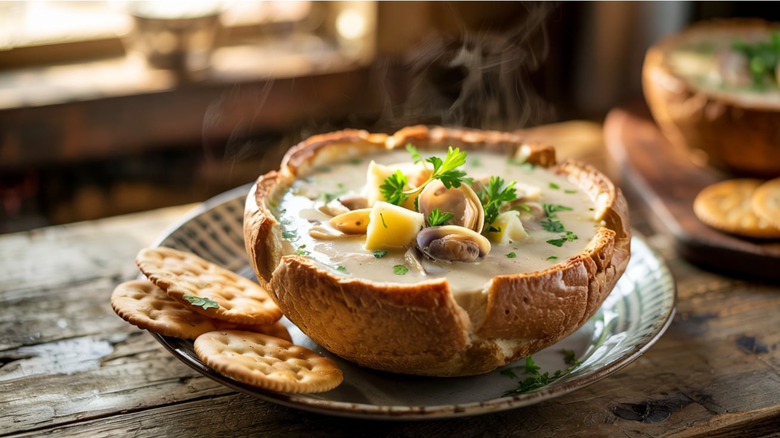
We bet you weren't thinking of serving oyster stew this New Year's Eve, huh? We don't blame you: Not a lot of people would. Nonetheless, there was a time when oyster stew was the dish to beat on New Year's Eve. It made its way to the United States by way of Irish immigrants who had left the country in the wake of the Great Famine. It was traditionally a Christmas Eve dish, although over time it became more associated with general festivities, and as it spread across the U.S., it turned into the kind of thing you'd find on New Year's tables.
There are several variations of oyster stew out there: The more traditional kinds are creamier and work with milder flavors, while spicier ones incorporate a little paprika or chili flakes to create more kick. We like to think that spicier versions also suit New Year's Eve a little more, creating just a touch more excitement on an evening that demands it. Regrettably, though, oyster stew has become a lot less common in recent years. Perhaps that's because oysters in general are considered fancier and are less likely to be thrown into a broth. Perhaps it's because it's not that suited to parties. Whatever the reason, you're probably not gonna see it dished up at your NYE bash.
Trifle
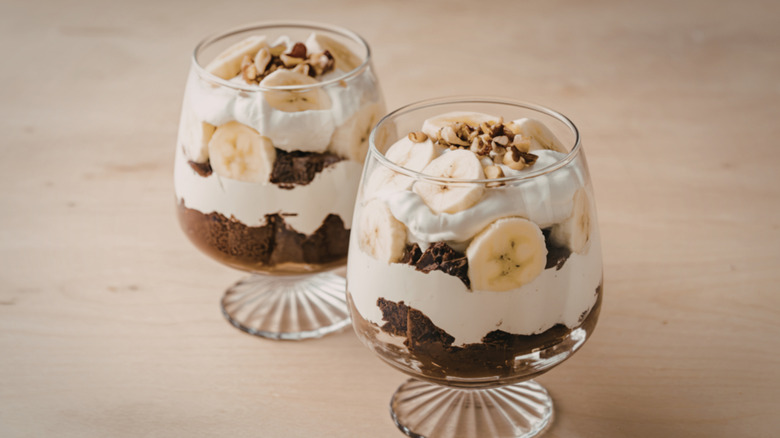
Few dishes evoke a sense of joy like a trifle. The quintessential British dessert can be found all year round, but it's particularly delightful when it's served during the holidays — and what better dish to ring in the New Year than a layered pudding, full of dynamic flavors? Trifle has an illustrious history: The dish first started taking shape in the 1700s, and it eventually travelled from the United Kingdom to the U.S., where it was also known as a Tipsy Parson. This charming name came from the alcohol in the dish, which would allegedly cause preachers to get a little more drunk than they potentially intended to.
Trifles are undeniably exciting desserts, and so it's little wonder that they came to be associated with New Year's Eve. They have a showstopping quality, as well as an adaptability that allows cooks to put in whatever they desire. There's no denying that they're a little impractical, though, and when you combine that with their time-consuming nature, it's probably no great shock that they're dying out as a New Year's dish. Maybe it's time to bring them back.
Tom and Jerry cocktail
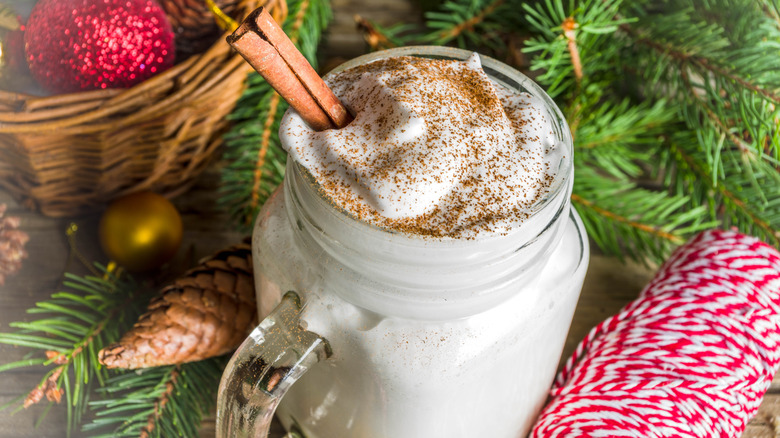
Okay, let's clear this up straight away: This cocktail is not named after the cartoon. In fact, the famous cat and mouse duo may have got their name from the drink we're about to discuss. The Tom and Jerry cocktail was invented long before the cartoon debuted, with the beverage first appearing in the mid-1800s before later becoming a classic holiday drink that was served on New Year's Eve. The Tom and Jerry cocktail, incidentally, may have received its own name from a play named "Tom and Jerry, or Life in London," although that's not been definitively proven.
What we can prove, though, is that the Tom and Jerry is delicious. This New Year's drink is an eggnog, and is made by combining brandy and rum with spices, eggs, sugar, and milk. It's boozy, rich, and tastes just like the holidays, but it also takes a lot of time to make — and it kinda feels just a little bit old-fashioned these days. It's fair to say that most people aren't whipping up a round of Tom and Jerry's when the clock strikes midnight this year, but we wish it would make a comeback.
Pickled herring
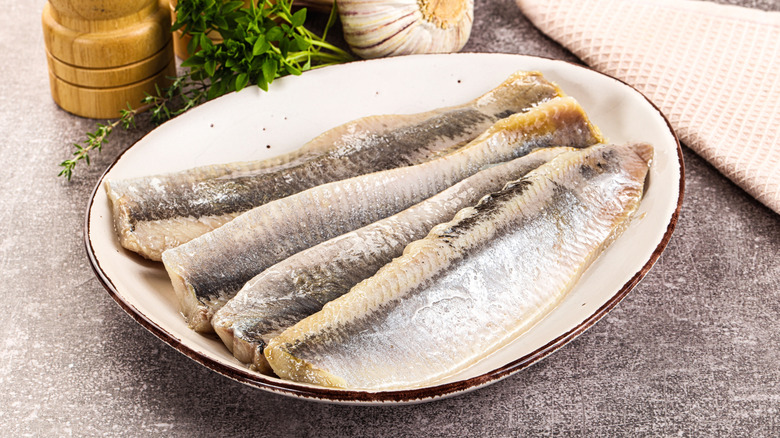
The practice of eating pickled herring on New Year's Eve hasn't entirely died out, but it's not a huge surprise that it's way less common than it once was. Pickled herring is considered a lucky dish to eat at New Year's in many communities, and is thought to encourage a better fishing catch in the coming year. Its roots sit in Northern Europe and Scandinavian countries, and when immigrants from these regions settled in the Midwest, they brought the food with them – and the tradition of eating it as the clock strikes midnight.
As generations have passed, though, the practice of eating pickled herring has slightly died out. It's now seen as the kind of thing that people's parents ate (and, potentially, that they have memories of being forced to try), and with each passing year, it's less likely to be served up. That being said, if you want a little more luck come January, it can't hurt to give them a try. You'll just have to be ready for a pretty fishy taste.
Stuffed mushrooms
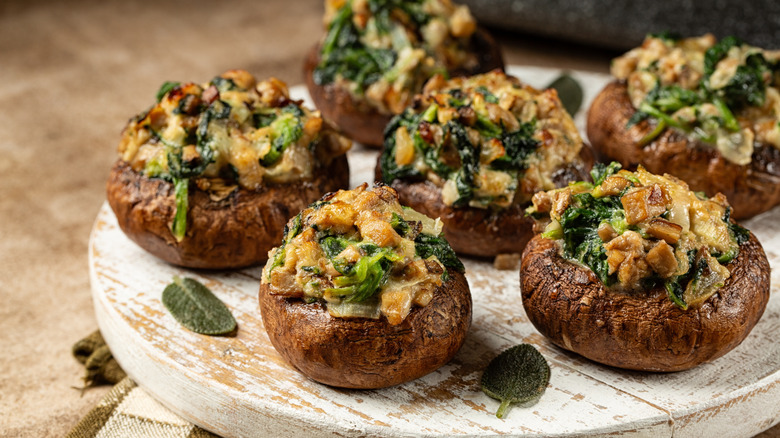
Stuffed mushrooms used to be a party classic, and we can see why. They're simultaneously approachable and indulgent, they're relatively easy to make, they're not super expensive, and they're a finger food that's perfect for passing around on a platter. It's no wonder that for a time, they were a New Year's Eve go-to, and they may well be found at certain soirées to this day.
However, stuffed mushrooms are also undeniably pretty retro. This dish first started becoming popular in the late 19th and early 20th centuries (although it may well have been first invented hundreds of years before this), and by the '70s, it was in its element. Now, though, finger foods tend to be a little more exotic, and the humble button mushroom doesn't often get a look-in. It's a shame, as there's something very charming about these little bites, and they're a great way to make a mushroom a lot more exciting.
Beef Wellington
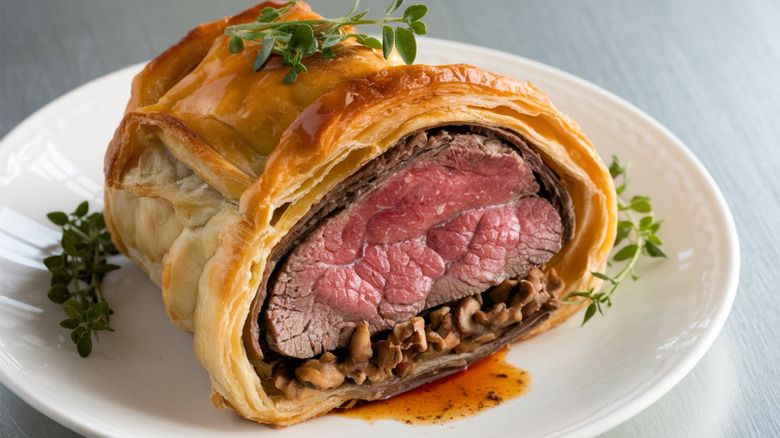
If you wanted extravagance on New Year's Eve, Beef Wellington was once the way to get it. This dish isn't exclusive to New Year's celebrations, of course – it can also be found at Christmas, or at any other dinner that demands a little elegance — but there's no denying that it's particularly suited to the occasion. Recipes for Beef Wellington began to appear in the 1940s, and from the outset, it was a dish that felt mature, sophisticated, and expensive. Consisting of a beef fillet coated in mushrooms and pâté and encased in a shell of pastry, making Beef Wellington is certainly not for the faint of heart, and it became a byword for next-level cooking. No wonder it was pioneered so heavily by chefs like Julia Child and James Beard, who contributed significantly to its popularity.
Sadly, its intricate nature is also likely what led to its downfall as an NYE food. Beef Wellington takes hours to prepare, and its ingredients cost a lot of money, so it's no surprise that people have started to move away from it in recent years, in search of less labor-intensive, expensive foods. As a result, it's something that's not seen very often these days on New Year's Eve, although you can still find it in plenty of high-end restaurants.