

The 1800s Cast Iron Cookware Brand You Never See Anymore
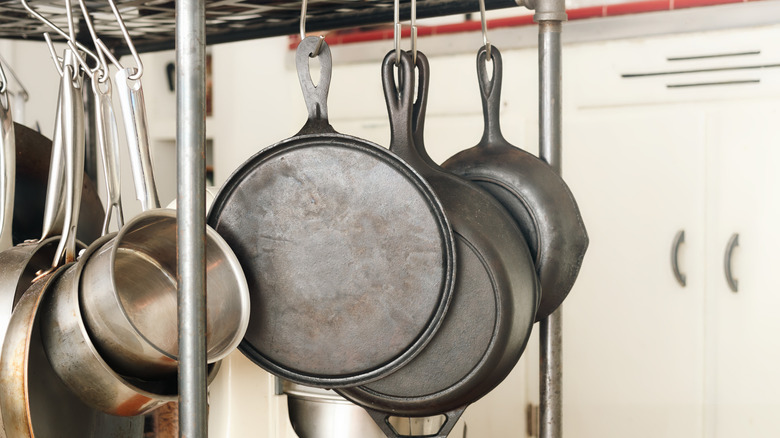
Home cooks and professional chefs alike love cast iron cookware, but not all cast iron is made equal. There are plenty of cast iron brands to buy and to avoid, and vintage cast iron is often worth buying both for historical appeal and collectability. This is especially true if the pan in question is a Griswold, one of the most sought-after vintage cast iron brands.
The Griswold Manufacturing Company of Erie, Pennsylvania, was family-owned and operated from 1885 to 1957. During this time, it became well-known for high-quality, lightweight cast iron cookware, especially a large line of skillets. Toward the end of family ownership, it even produced unbranded versions of its cookware for Sears, expanding the pool of these now-collectibles.
Although the Griswold brand continued under new ownership for a few years after 1957, these pieces are generally not considered collectible. Some cookware from the family-owned era, however, can easily be worth hundreds if not thousands of dollars. But not every pan is a jackpot; there's a lot to watch out for — both with vintage cast iron in general, and Griswold specifically.
What to look for when thrifting vintage cast iron
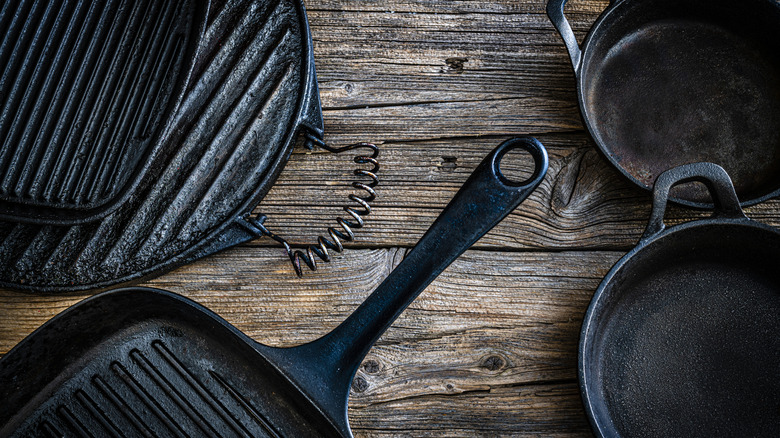
Thrifting is a great way to find many things, from kitchen islands to Tiffany glassware. It's also a good way to pick up vintage cast iron, though there are a few obvious dealbreakers to look for. Major damage like large chips, cracks, or holes is difficult and expensive to fix, and welded cast iron repairs are prone to breaking again, to say nothing of diminished collector value.
On the other hand, rusty cast iron is often worth restoring so long as the iron isn't corroded through. Rust may also cause unusual indentations in the pan, known as pitting. Depending on the extent of the damage, a pitted pan may still have some value, but it will be greatly reduced since pitting cannot be repaired and can pose problems with cooking even when the piece is otherwise restored.
Vintage cast iron also tends to be thinner than thick, modern pans like Lodge makes, which means they're more prone to warping over time. When placed on a flat surface, warped pans will rock, spin, or wobble a bit if touched. Warped pans are unusable on flat cooktops because the bottom cannot make consistent contact with the heat source. This greatly reduces value, but they may still be suitable for cooking on gas stoves, in ovens, or over open flame.
Watch out for fake Griswolds
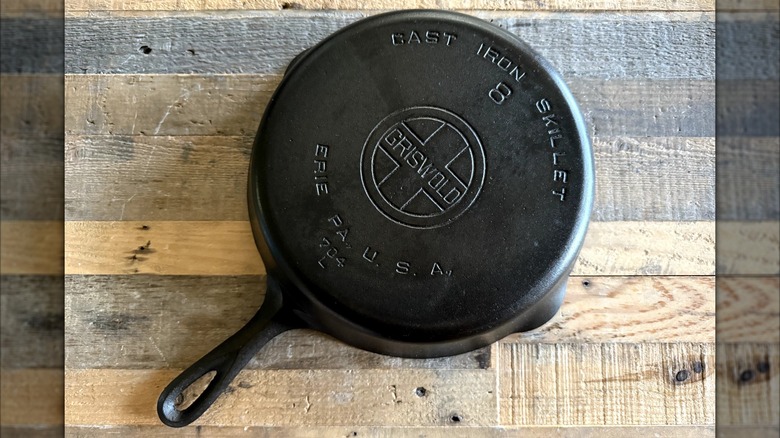
When it comes to specifically prized brands like Griswold, counterfeits are unfortunately a fact of the market. And like any collector's item, if it seems too good to be true, it probably is. For instance, Griswold 13 pans (named for their stamped 13 indicating size) are extraordinarily rare, and have sold at auction in great condition for almost $5,000. Miracles happen, but if you find an unusually affordable Griswold 13 in any condition, be suspicious.
Correct markings are also a good way to spot genuine pieces, but Griswold used at least 10 different logos on their pans, including a few that omit the company name. Consult a guide to the different pan markings, like The Book of Wagner & Griswold, before making a purchase. Obvious misspellings like "GRISWQLD" can be a tell, though there are three known legitimate misprints: a "GIRSWOLD" pot lid, a "DUTOH" oven, and a "Squar" Egg Skillet."
Counterfeit Griswolds also tend to be smaller pieces, to simulate the genuine toy pieces that are valuable. But that cheapness shows up elsewhere; counterfeit pans of any size often have poor casting quality, with rough edges and sides. Counterfeit pans also tend to be inauthentically heavier than real Griswolds, an artifact of the cloning process, which often uses a cast made from the genuine article.