

Why Pistachios Were Red For Decades (And What Happened To Them)
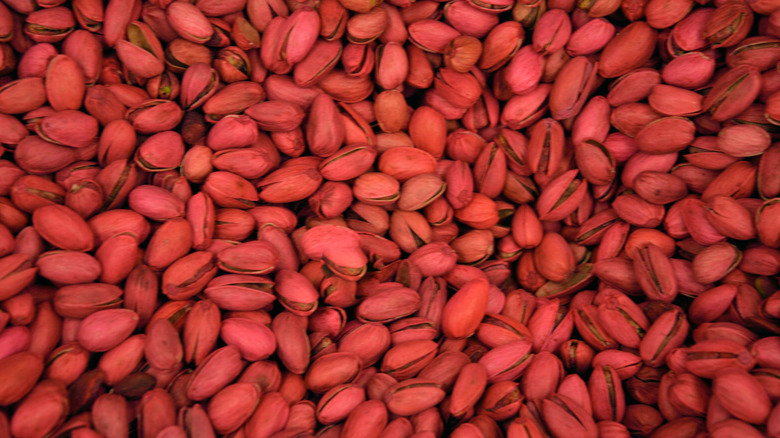
If your kids ever called you crazy when you told them pistachios used to be red, we're here to reaffirm your knowledge. You aren't wrong, pistachios used to be red, but it was thanks to a dye. If you doubt yourself, you can watch the original "Naked Gun" movie to see the characters Frank Drebin and Ed Hocken eating the little red nuts, fingers and lips stained with red dye, as they watch a suspect from a car. So where did that dye go? And how did it even get on a pistachio in the first place?
There are two stories of how pistachios came to be dyed red. The most commonly told tale is that the dye was applied to hide cosmetic imperfections in the shell. This was caused by Iranian farmers not removing the meaty, acidic hull soon enough after harvest. The chemicals in the hull would stain the shell, so they dyed them red before sending them abroad. A story from 1986 in the LA Times says this narrative is not true, claiming a street vendor in Brooklyn dyed his nuts red to get attention. The idea allegedly worked but was quickly copied. That said, most food historians back the stained shell theory.
So where did the red pistachios go?

Pistachios weren't harvested in California until 1977. Pistachio trees don't start producing until they are at least six years old, but it really takes 10 years for a tree to hit its stride. These California farmers removed the hulls within the required 24 hours to avoid staining. They could have always sold them unshelled, but taking off the shell is a part of the pistachio charm.
Then, in 1979, the Iran hostage crisis hit. President Carter eventually put an all-out embargo on Iran, and that included their pistachios. Luckily California was prepared to fill the demand as the trees planted in the Central Valley were getting closer to full maturity. Now, as the popularity of the nut is only getting bigger, the state produces 98% of the U.S.'s pistachios.
It also didn't help the red nut's cause that Red Dye Number 2 was banned in the late 70s. Public concern even resulted in M&Ms removing the red M&M from their line, even though it never contained the substance. The studies were flawed, and a human would have to drink 7,500 cans of red-colored soda a day to reach the levels that supposedly caused cancer in the rats, but the public began avoiding anything dyed red.