

This Old-School French Dish Combines Salmon And Puff Pastry
Beef Wellington suggests, "You are classy, you know how to cook, and you've seen at least one video of Gordon Ramsay making it." But the dish, while delicious, is also quite costly, high-maintenance, and often served only on special occasions like Christmas dinner. But there's also a low-key version of it: An old-school French dish called Salmon Wellington, or salmon en croûte.
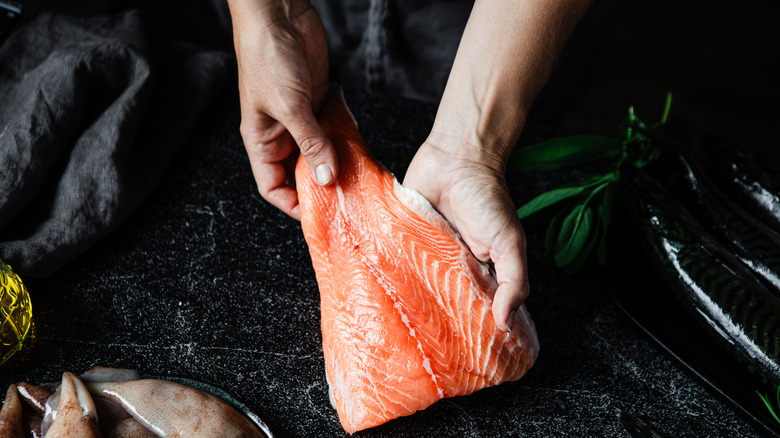
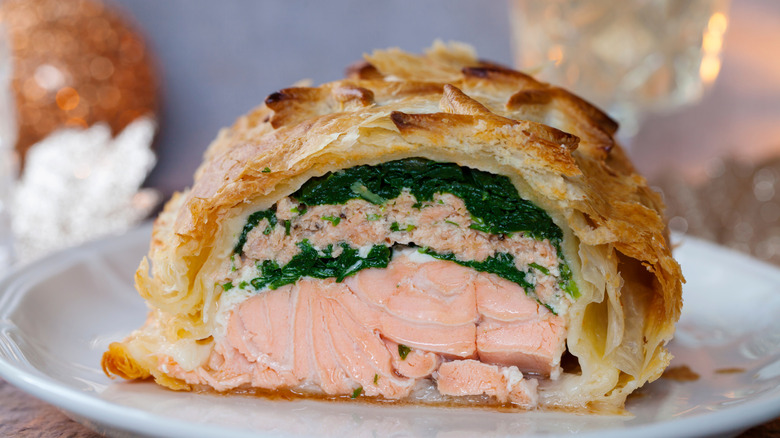
Salmon en croûte follows the same technique as its meaty counterpart but uses different ingredients. The dish replaces the beef tenderloin, mushrooms, and Parma ham with salmon fillets, spinach, herbs, and a creamy filling, wrapped in puff pastry. "En croûte" translates to "in a crust" in French. Bake it for buttery, flaky, layered perfection. The dish is increasingly popular among modern home cooks who want to prepare something with the grandiosity of Beef Wellington, but prefer a much lighter, easier-to-make dish that will do for a weeknight dinner.
Where did Salmon Wellington come from?
Salmon Wellington's origins are as layered as the omega-3-rich dish itself. The recipe is a loose interpretation of another French dish, coulibiac, which was itself inspired by a festive Russian dish called kulebyaka. Popular in pre-revolutionary Russia, kulebyaka is one of the pies from around the globe that you've been sleeping on; it's an oblong pie with layers of different fillings, usually salmon or another fish, rice or buckwheat, and other proteins and vegetables, separated by thin pancakes to keep the ingredients apart.
This extravagant dish was an indulgence for the upper class, often served at the tsars' tables. It was intricate, time-consuming, and expensive. Russian author Anton Chekhov described kulebyaka in his short story "The Siren" as "a temptation to sin." The renowned French chef and cookbook author Auguste Escoffier learned to make coulibiac to impress Russian navy officers visiting his uncle's restaurant in Nice, who were missing a taste of home. He included the coulibiac recipe in his cookbook "Le Guide Culinaire," and it featured salmon, rice, hard-boiled eggs, mushrooms, onions, and dill, all layered inside pastry. The recipe was still quite a project until Julia Child simplified it for a wider audience, so home cooks could tackle it without spending quite so much time in the kitchen. Salmon en croûte is even more manageable, adapted for the busy lives we lead nowadays.