

The Legal Loophole Behind The 'Fresh' Chicken Americans Buy Every Day
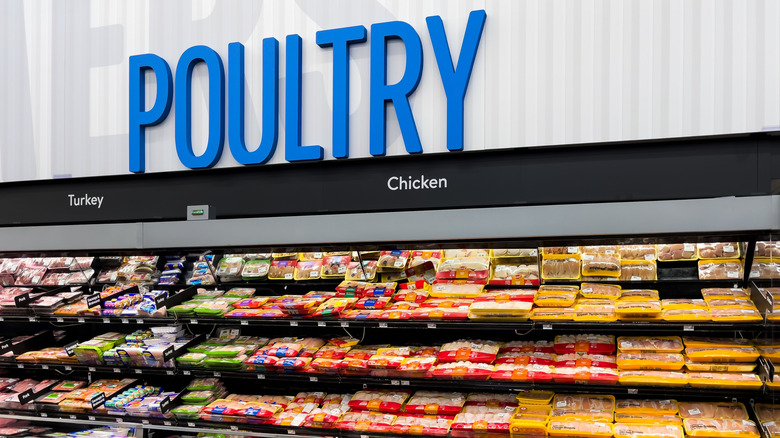
An increasing number of U.S. consumers are reading labels more closely and expect clear, detailed information across the board when it comes to food labeling; this includes a desire to better understand meat labels. Meat products have been affected by various labeling issues, including in relation to ethical and sustainability claims, which can be unfounded. These unclear labeling practices can also apply to processing, with processing-related wording often needing explanation. One primary food labeling practice that American consumers will be interested to learn about relates to the use of 'fresh' labels for raw chicken (and other poultry such as turkey).
Under USDA guidelines, raw poultry can be labeled 'fresh' as long as it has never been stored at temperatures below 26 degrees Fahrenheit. A potential issue with this guideline is that water in poultry can begin freezing at 28 degrees Fahrenheit, and the USDA has found that ice formation can occur in poultry at 27 degrees Fahrenheit, despite this temperature falling under its own definition of 'fresh.'
Along with the fact that consumers may think "fresh" means no ice has ever formed in the meat, poultry that has formed ice at some point can present culinary issues, such as unexpected changes in texture. To unpack this a little more and understand exactly what you could be getting when purchasing 'fresh' chicken in the U.S., read on to discover more about this labeling practice.
What qualifies as fresh chicken in the US?
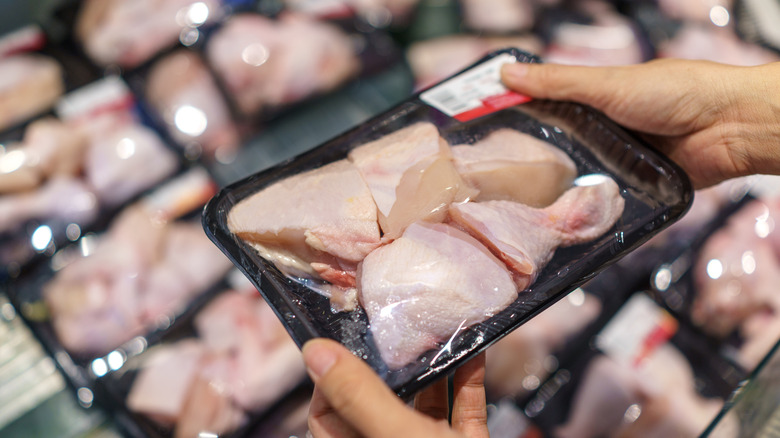
In the U.S., raw chicken or other poultry that has been held at 0 degrees Fahrenheit or below must be labeled as frozen. Conversely, raw poultry that has never been stored below 26 degrees Fahrenheit can be labeled 'fresh' and must have a 'keep refrigerated' label. Poultry held between those two temperatures cannot be labeled 'fresh' but is not required to be labeled 'keep frozen.' But storage at temperatures deemed sufficient for a 'fresh' label doesn't guarantee that no freezing of water content has occurred. The USDA's reasoning is that at around 26 degrees Fahrenheit, the raw product remains pliable, even if some ice crystals have formed. Below 26 degrees Fahrenheit, you risk too much water turning to ice, and the product becomes firm to the touch, making it ineligible to be classified as 'fresh.'
Whether this is an issue depends on what consumers understand 'fresh' to mean. Those who think it should mean that no ice formation has occurred may not be satisfied with the USDA's definition. If you fall under that category and want to increase the chances of buying poultry you deem fresh for your recipes specifically using chicken breasts, you should be especially concerned about ice crystal formation, as this cut contains a high water content of around 75%.
While ice formation can potentially alter texture, there are no microbiological concerns associated with purchasing refrigerated poultry labeled 'fresh' under USDA guidelines, even if some ice formation has occurred. If you want to reduce the likelihood of purchasing poultry that has formed ice, press the meat to see if it has elasticity, primarily focusing on the thicker parts around the center. Also check for visible ice crystals. Keep in mind, even if the poultry is fully pliable with no ice crystals, you cannot guarantee that it did not have ice formation at some point. Purchasing from a supplier that can confirm processing and storage of the poultry can be wise if this remains a concern.