

Instant Pot Vs Pressure Cooker: What's The Difference?
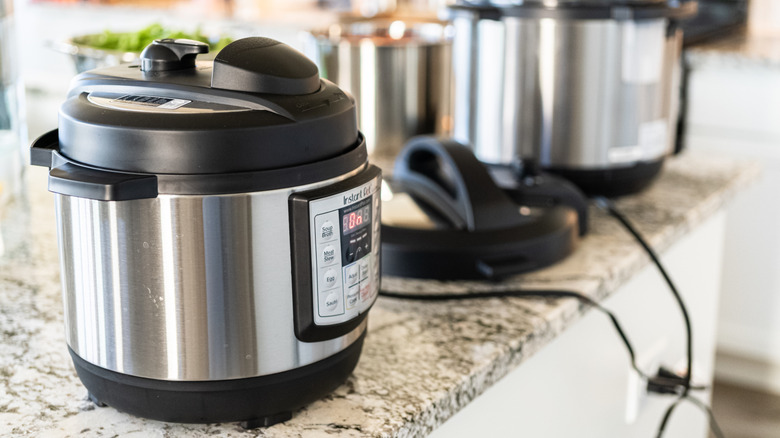
Just like Crock-Pot became shorthand for slow cooker, and Tupperware is often what we call plastic containers — the name Instant Pot has now become interchangeable with pressure cooker in common kitchen conversations. It could be said that the Instant Pot reached icon status on Prime Day 2017 and became the new term for pressure cooker since then. The problem is, the Instant Pot is not technically a pressure cooker. The two differ in quite a few ways — most significantly in versatility, which is often the case when you compare a single-purpose kitchen tool to a multi-purpose one.
It's pretty easy to tell the difference between a slow cooker and a pressure cooker. One cooks food over a period of hours to slowly bring out juices and flavor, while the other uses pressure to create high-temperature steam to do the same at a faster rate. The differences between an Instant Pot and a pressure cooker can be a little more difficult to suss out. Many of the differences can be explained by the overall purpose of the appliance or pot. All Instant Pots can be pressure cookers, but not all pressure cookers are Instant Pots. To understand why the two aren't interchangeable, it's best to have a thorough understanding of how they work to create a dish in your kitchen like, say, a tasty beef stew.
Pressure cookers cook faster, but Instant Pots do more
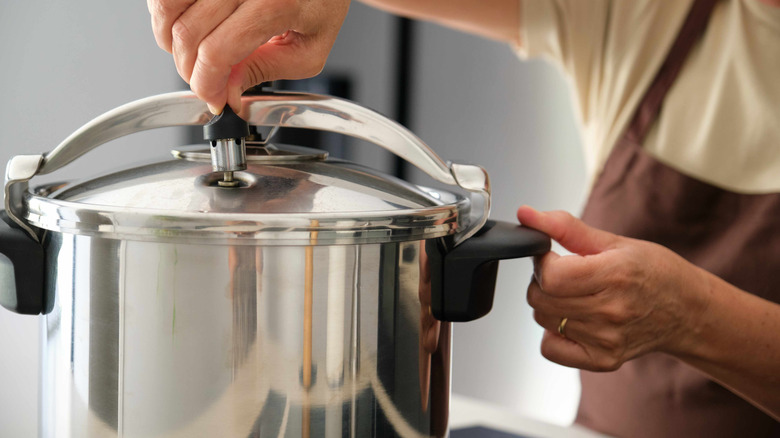
A pressure cooker is a pot that is heated via the stovetop. Add your ingredients to the pressure cooker along with some liquid, attach the lockable lid with pressure release, and cook for the recipe's specified time. The reason a pressure cooker cooks so well and so fast is that it creates a pressurized environment up to 15 psi, which forces temperatures to reach around 250 degrees Fahrenheit. That's why you can end up with something as good as a slow cooker pot roast in a matter of minutes instead of hours. The pressure cooker does one thing, and it does it well!
Unlike the pressure cooker, the Instant Pot is considered a multi-cooker, meaning not only can it perform a pressure-cooking function, but it also has many other settings depending on the model. Where this becomes an issue is that these multi-cookers often can only reach a certain psi. According to the Instant Pot website, the average model reaches 10.2 to 11.6 psi on the high setting. There are some other significant differences from a pressure cooker: with an Instant Pot, you can't manually adjust the heat, and it requires a pre-heat period to get up to pressure, which can add more to your cooking time. While you gain versatility and hands-off capability with the Instant Pot, you lose fast and consistent pressure-cooking ability. It really comes down to what matters to you: a pot that does one type of cooking amazingly well or one that does multiple things decently well.