

Use A Saucepan And Water To Perfectly Proof Chocolate Croissants

Few things make the intricacies of home baking as worthwhile as a chocolate croissant still warm from the oven with steam rising off its egg-wash shine. That moment when you bite into it — and your teeth crunch through the successive crisp layers until finding the earthy-sweet chocolate filling — is an experience not really obtainable in the retail world. That is, unless you live near a reputable patisserie and get up awfully early in the morning.
Anyone with a passing knowledge of how croissants are made is aware that they can be tricky devils: You need to laminate the dough without splitting; you need to keep the butter cold; and — vitally — you need to proof the shaped and filled dough just prior to baking. The good news is that you don't need anything fancy to do this aside from a saucepan filled with water.
In order for yeast to ply its trade, it needs warmth and moisture: The former makes it active while the latter keeps the dough from drying out and impeding the yeast's process. Proofing your shaped chocolate croissants involves nothing more than keeping them in a tolerably warm (around 80 degrees Fahrenheit), decently humid place for about an hour and a half.
The proof is in the proofing
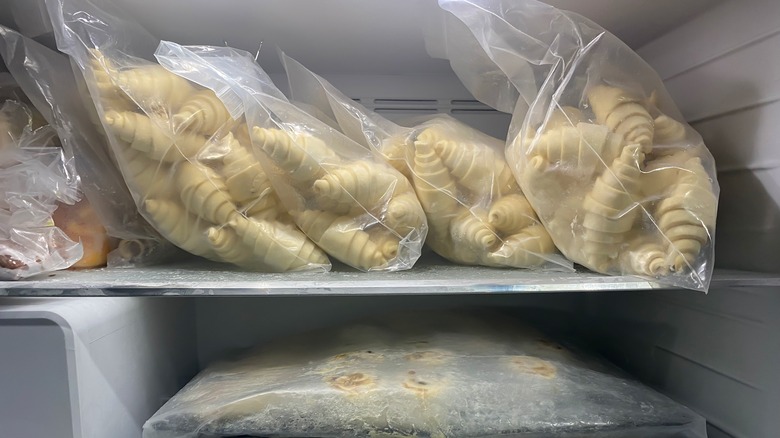
Yeast, our ancient and reliable fungal friend, has gifted the human race everything from wine to bread. In essence, it likes to eat sugar and expel carbon dioxide. When combined with the stretchy qualities of gluten (fed by the sugars of carbohydrates), this can lead to some truly marvelous results, like the tiny air pockets that form between layers of laminated croissant dough. You can be the best laminator in the world, but if you don't proof your croissants properly, it will be all for naught.
A dry dough exterior is great if you want to bake crusty bread; it's not so hot for more delicate things like chocolate croissants. Just as yeast needs a minimum temperature to ferment, dough needs a minimum humidity — at least 75% — to keep from drying out. Of course, you can preheat your oven to a low temperature, turn it off to cool sufficiently to not kill off the yeast cells, and then put a pot of boiling water in with the baking tray so the steam will create a proofing sauna. Or, you could keep the proofing space moderately warm and have a saucepan of water nearby to keep the air from drying out. It's your call.
Avoid under-proofing and over-proofing

Now that you've got an ideal proofing environment for your chocolate croissant children, you're going to want to avoid two unwanted outcomes: under-proofing and over-proofing.
Under-proofing is simply not giving the yeast enough time to do its job of gobbling up sugars and creating carbon dioxide. The process should last no less than 75 minutes and no more than 90 minutes. Give your croissant dough a Pillsbury Doughboy poke toward the end of the proofing process. If it doesn't take a moment to bounce back, it's under-proofed.
Over-proofing, as you've no doubt deduced, is losing those needed air pockets. Worse, it means you've come too close to exhausting the yeast's ability to produce carbon dioxide gas and create more air bubbles. The sure-fire tell that a dough is over-proofed is if it doesn't spring back at all when poked. Because of this, it's a good idea to test your croissant dough before the maximum proofing time has elapsed.