

The '50s Kitchen Tool That's Still Widely Used Today
We may receive a commission on purchases made from links.
Every cook has a set of essential kitchen tools in their utensil drawer, but aside from a trusty chef's knife, there might also be a modern garlic press, a new-fangled microplane, or even a candy thermometer snuggled inside there too. Many years ago, it was the kitchen gadgets from the 50s that were arguably the most fabulous. From handheld ice crushers and green bean slicers to cherry pitters and butter molds, there were plenty of trendy kitchen gizmos designed to aid the home cook. One such tool that's still widely used today is the tomato slicer.
A tomato slicer is rectangular in shape and has a handle at one end. Along its width are several equally spaced metal serrated blades running in parallel. To slice a tomato into rounds, you simply place the slicer on top and use a sawing motion to cut all the way down, flipping it over at the very end to slice all the way through. As the blades are serrated, the slicer can cut through firm and ripe tomatoes neatly.
The packaging on an Ekco Miracle tomato slicer from the 1950s said it could be used to slice cucumbers, carrots, eggs, butter, and cheese too. In fact, plenty of Facebook users responding to someone's post asking what it was called called it an egg slicer. Additionally, tomato slicers featuring the same design are still available on Amazon today, highlighting their appeal and practicality.
The simple design of '50s tomato slicer is yet to be matched
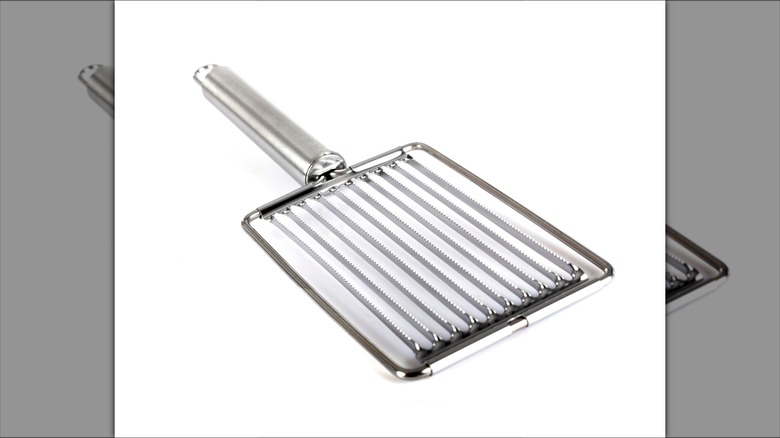
While there are plenty of new tools on the market for slicing tomatoes, the original 1950s design has stuck around for so long because of its convenience. Firstly, it's slimline enough to fit inside a drawer without taking up too much prime real estate. Of course, it's designed to be wide enough to accommodate a large tomato, but it also lies flat and doesn't have any extraneous fiddly bits. In contrast, some modern tomato slicers are too chunky and take up space. For instance, there's one variety of plastic tomato slicer that comes in two parts — you place the tomato on the base and press a second bladed piece onto it. Even though it collects any errant seeds and juice in the bottom, it's finicky to clean due to its convoluted design.
Meanwhile, mandolin slicers are slimmer and easier to clean but also tend to be much longer, making them tricky to store away in a compact space. Plus, you need to use a guard to safeguard your fingers while you slice your tomatoes. Why make the job harder when you can stick with the classic design and create perfectly portioned slices of Heirloom tomatoes for a pretty Caprese salad in seconds?