
The Prime Rib Cooking Time Rule For A Juicy, Medium-Rare Roast
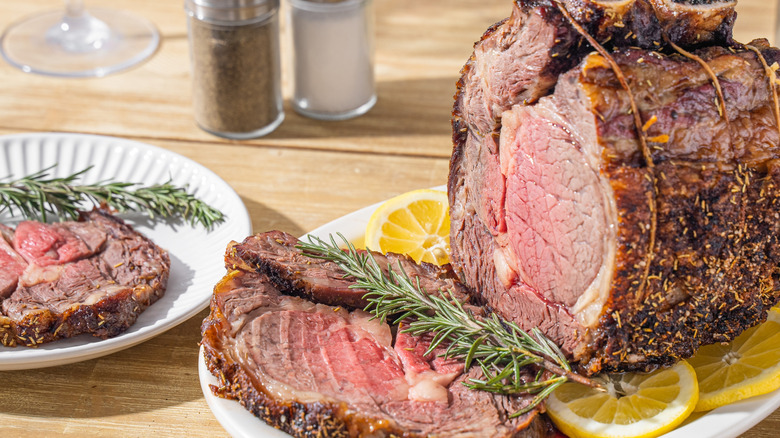
When selecting a prime rib for roasting, the trick is to check that it has plenty of fatty marbling running throughout. This will guarantee that your beef remains juicy and moist in the middle as the fat melts into the meat. It's also essential to keep your eye on the clock. Roast your beef for too long and you could end up with a dry hunk of chewy meat that's lost its magic no matter how abundant the fatty marbling or perfect the prime rib recipe. Conversely, if you pull it out of the oven too early, it will likely still be mooing in the center. Luckily, we've got you covered. The prime rib cooking time rule for a juicy, medium-rare roast is to bake it until the internal temperature reaches 130 degrees Fahrenheit, which should take around 13-14 minutes per pound with the oven set to 500 degrees Fahrenheit.
However, there is some flexibility around this rule depending on the make and model of your oven. Some recipes recommend allowing 20 minutes of cooking time per pound, but it's better to err on the side of caution, as you can always roast it for longer if the internal temperature isn't high enough.
If you're cooking for a family of five, you'll need a roast that weighs five pounds (one pound of bone-in prime rib per person). This would equate to a cook time of 65-70 minutes. Shorten the time for a rare roast, or lengthen it for medium well.
A meat thermometer is an essential when cooking prime rib
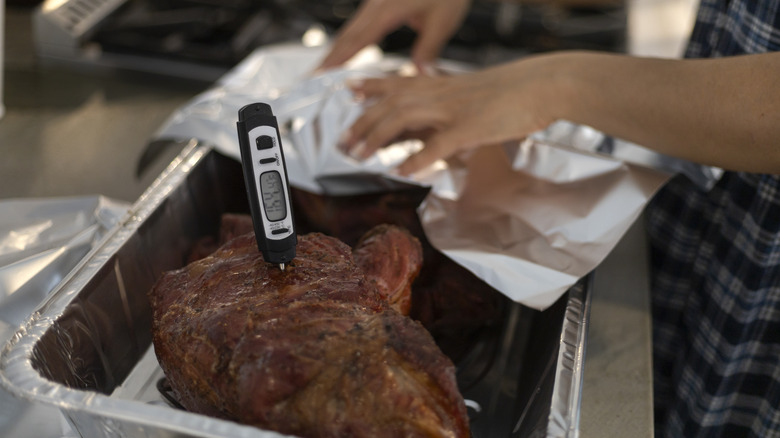
If you're a practiced home cook, you can likely whip up a meal without a recipe and eyeball all the measurements. Unfortunately, the same can't be said for roasting a prime rib. As there is no way of knowing whether the center has reached that perfect sweet spot without cutting it open, you need to have a rough idea of its weight so you can calculate how long to cook it for best results. That is, unless you have a meat thermometer on hand. While you might not consider this item to be an essential piece of a culinary kit, it is a truly indispensable tool when it comes to checking the doneness of any large roast. As the oven temperatures can vary, a meat thermometer takes out the guesswork.
If you want to cook prime rib perfectly, always allow it to rest. The beef will continue to cook in the residual heat, and the texture will be perfect for carving. For a flavor-packed prime rib, consider using a smoker. This low and slow cooking technique renders down the rich marbling in the beef, resulting in a tender and succulent result. It also has the added benefit of imbuing the beef with a savory and smoky quality that can't be achieved via an oven roast.