

Stop Making These Common Mistakes At Indian Restaurants
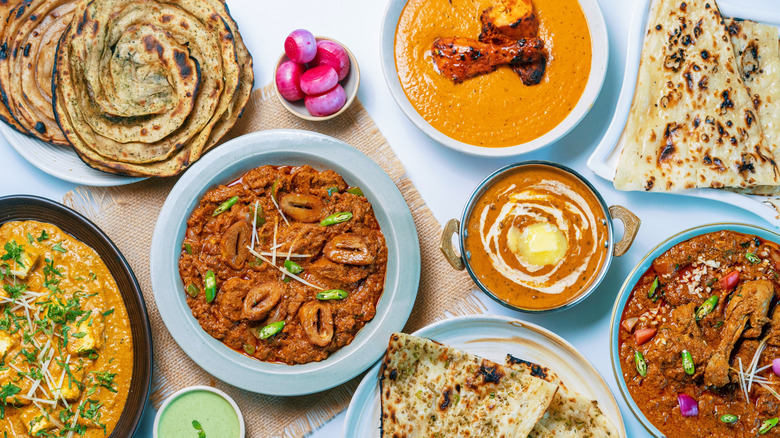
Do you love spicy food? I bet you can't help but visit Indian restaurants every now and then. The United States, fortunately, has some really amazing ones, thanks to the massive Indian population. Indian restaurants are the perfect place for many Americans to enjoy an elaborate, delicious meal.
Even though many diners have been regulars at Indian restaurants for ages, they still make a few common mistakes whenever they visit. There isn't anything inherently wrong with making these blunders, to be honest. The owners of these restaurants definitely won't kick you out just because you don't know how to pronounce the names of certain dishes or are clueless about how they are made. But keeping these harmless slip-ups aside, there are a few other common mistakes you should stop making at Indian restaurants, because whether you've realised it or not, they have been getting in the way of you having a great experience.
As an Indian, I always pointed out these mistakes whenever I visited Indian restaurants with my British friends in London while pursuing my diploma. I also helped them understand what they should do instead, and they always thanked me for that, just like you might after reading this article. Besides my cultural background, I've also interned at a few Indian restaurants, so you can absolutely trust me to highlight some common mistakes you might want to avoid. So, let's get to them.
Skipping vegetarian options
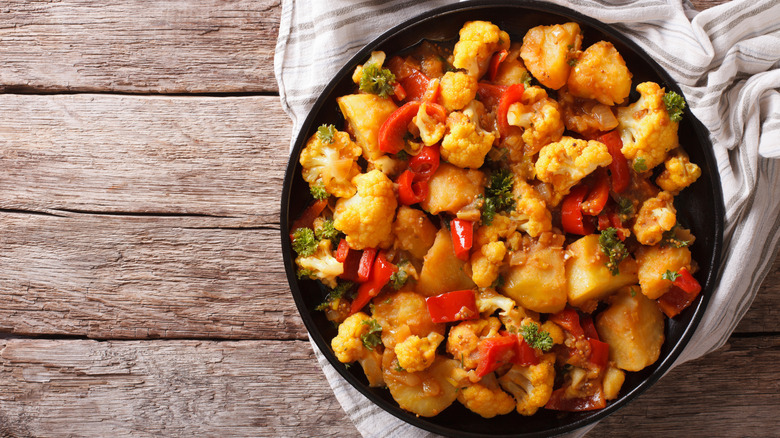
Many Indians are pure vegetarians, so vegetarian food is never an afterthought in this cuisine — it's made with just as much love and effort as any non-vegetarian dish. So, it's obvious that even though chicken, fish, and lamb-based dishes are quite tasty, vegetarian foods will be just as delicious. Considering that, if you've so far been skipping vegetarian options at Indian restaurants, that's a mistake that you need to stop making.
Honestly, there are several Indian side dishes you need to order if you want to explore the underrated vegetarian side of this cuisine. While some of these side dishes are still somewhat popular among American diners, like samosas and onion bhajis, there are a few others that are worth a shot if you haven't tried them yet. These include vegetarian kebabs, pani puri, pav bhaji, and paneer-based appetizers. You should also consider ordering vegetarian mains like aloo gobi, kadai paneer, vegetable jalfrezi, palak paneer, dal makhani, and red lentil dal along with naan or rice for a wholesome meal.
These are just a few vegetarian options, and most of them are a part of North Indian cuisine. If you visit an Indian restaurant that serves South, East, or West Indian cuisines, you'll find a whole other variety of vegetarian dishes on its menu, all worth trying out. Be sure to ask the server about each dish if you're confused, but don't skip ordering them just because you aren't sure what they are.
Not asking the server how spicy a dish is before ordering
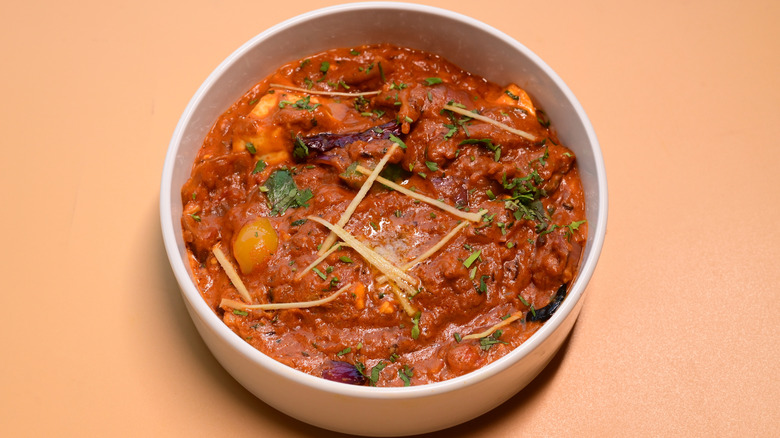
Most of you already know that Indian food can be spicy. Despite being aware of this, you might be making the mistake of not asking the server how spicy a dish is before ordering at Indian restaurants. The reason this qualifies as a blunder is that some dishes can be a lot hotter than you could imagine, as they contain a lot of green chiles or even worse, bhut jolokia, which is also known as ghost pepper.
Truthfully, these dishes can be a lot to handle even for Indians. So, if you end up ordering something that contains either of these ingredients, you'll be in for an unpleasant surprise, even if you have a high spice tolerance. The worst part is that you might not even be able to eat what you've ordered, and you'll essentially end up wasting your money.
It's worth noting here that some dishes can also be a lot milder than you would've thought they'd be, like malai kofta, methi matar malai, and korma. Not asking how spicy something is can backfire in this case, as you'd expect something fiery, only to be served a mildly sweet dish. Since there's a lot that can go wrong if you don't ask, it's ideal to check with your server how hot or spicy a dish is before you order it.
Not eating with your hands
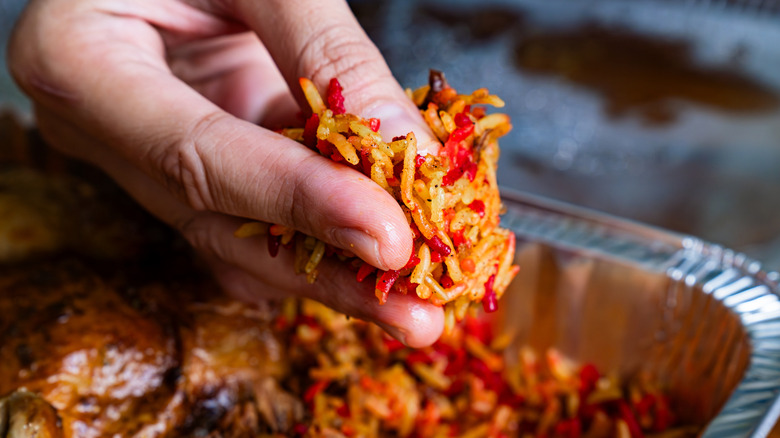
Perhaps this is one of those blunders for which you can get a clean chit, because honestly, no one at an Indian restaurant will judge you for using cutlery. However, if you want to try an authentic Indian dining experience, I'd recommend eating with your hands.
You might think that most Indians eat with their hands just because it's convenient for them, which is true, albeit only partly. Sure, cutting up roti, naan, or any other bread with a fork and knife is a task, so eating these items with your hands is about convenience. But when it comes to rice, curries, kebabs, or anything else, it's more about traditional beliefs. In Indian culture, it's believed that eating with your hands brings you closer to your food and also makes it taste better. With that in mind, even though you might struggle in the beginning, you should still eat all the food you order at an Indian restaurant with your hands if you're really into exploring different cultures.
While using your hands to eat is encouraged, avoid using your left hand. That is actually considered highly disrespectful by most Indians because the left hand is usually used for personal hygiene. Use it only to pass dishes around and to serve yourself or someone else. Other than that, always stick to the right hand to be safe.
Assuming every curry tastes the same
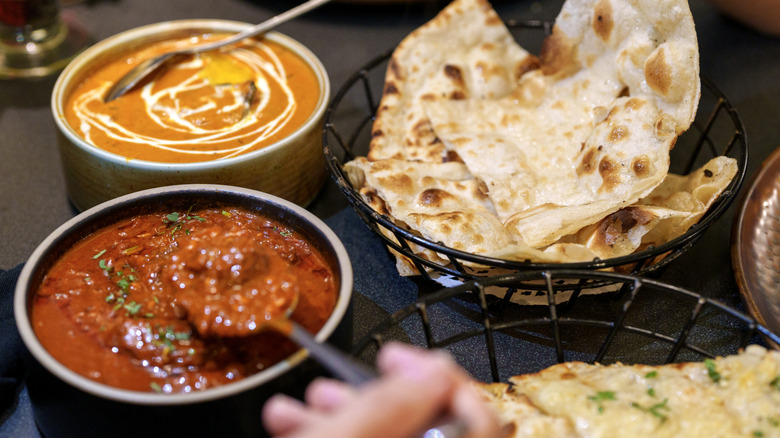
Even though quite a few Indian curries look similar, it's a mistake to assume that they all taste the same, too. This is because if you believe that, you might order a curry thinking it tastes a particular way, only to be shocked when it tastes nothing like you imagined.
Let's understand this better with a few examples. Butter chicken and chicken tikka masala are two really popular Indian dishes that look quite similar because both have a tomato-based gravy. But they don't taste the same, and you'd know that if you're a true fan of these curries. Butter chicken tends to be a little sweeter and creamier, as cashews are used to make the curry base. Tikka masala, on the other hand, is tangier as yogurt is used for marinating the chicken, and it also doesn't have any cashews. So, if you end up ordering it believing it will taste mild and creamy like butter chicken, you'll definitely be disappointed.
An even bigger blunder would be ordering kadai chicken (also a tomato-based curry), believing it will taste the same as butter chicken. The former tends to be a lot spicier, and if you have a low heat tolerance, you won't be pleased after eating it. Taking this into account, it's better not to judge curries by pictures and instead ask the server how each one of them tastes before ordering.
Eating rice and bread at the same time
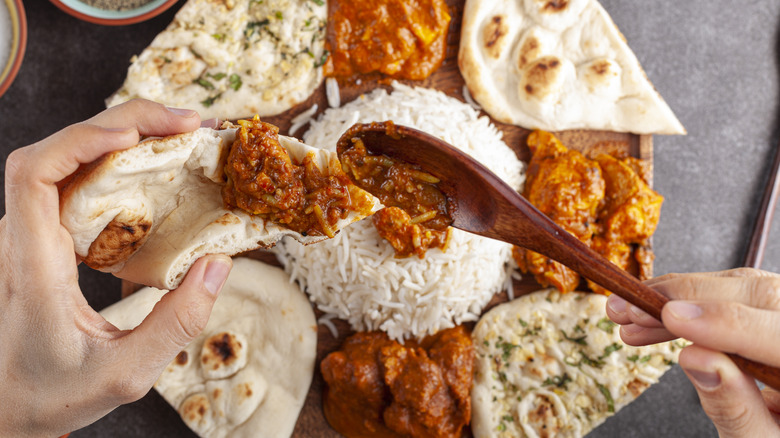
Indian meals aren't served in courses — that's true. Despite that, there are certain unspoken rules about what should be eaten when. One of these rules is that rice and bread shouldn't be eaten at the same time. So, if you're one of those people who mix your rice dish with curry and then use the bread to scoop all that up, you've been making a mistake.
Sure, this one may not seem like a slip-up, mainly because there's nothing inherently wrong with eating rice and bread together. However, it's worth noting that most Indians usually eat breads like roti, paratha, or naan first with curry or a dry vegetable-based dish, and then move on to plain rice, pulao, or even a delicious Hyderabadi biryani. The logic behind this is that eating rice and bread together means you'll end up with a lot of carbohydrates at once. Besides that, it will create an unbalanced-tasting dish: The rice will mellow the curry's flavor, and then the bread will make everything taste even milder, which isn't how it's supposed to be.
I'd recommend ordering your favorite bread and curry first and then moving on to rice. Or, if you want to eat both at the same time, take smaller portions and don't use the bread to scoop the rice, so you can savor the actual flavors of all the dishes.
Assuming all vegetarian dishes are vegan-friendly
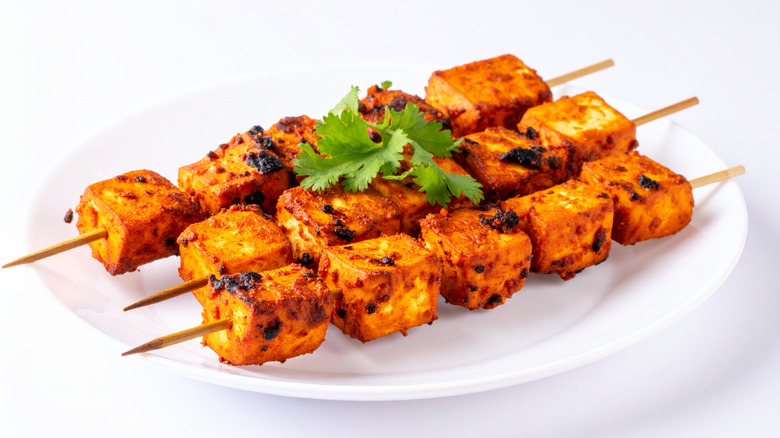
It's true that vegetarian dishes are an integral part of Indian cuisine. At the same time, not all of these dishes are completely plant-based, and so they can't be classified as vegan-friendly. The reason is that Indian cuisine relies heavily on dairy products like milk, cream, paneer and chenna (types of Indian cheeses), and ghee, which, let's just say, most Indians can't live without. Keeping that in mind, it's ideal to first check with the server if the vegetarian dish you're planning to order contains any dairy.
That said, many Indian dishes are naturally vegan-friendly, or can be made that way. For instance, you can actually request the chef to replace ghee with oil to make a dish completely plant-based. This is especially true for South Indian dishes like dosas and idlis, which are made with a fermented rice-and-lentil batter, and ghee is used only to cook them and add some flavor.
If you're at an Indian restaurant that serves quintessential North Indian food, bear in mind that rotis, parathas, and naans are also topped with ghee or butter. But the good news is that you can order them plain instead; other than ghee, these breads are technically vegan. Speaking of North Indian curries that contain milk or heavy cream, just tell the server that you'd want them to be made vegan, and the chef will most likely replace the dairy-based ingredients with nut-based milk to give them that same creamy finish.
Ordering individual portions for everyone instead of sharing meals
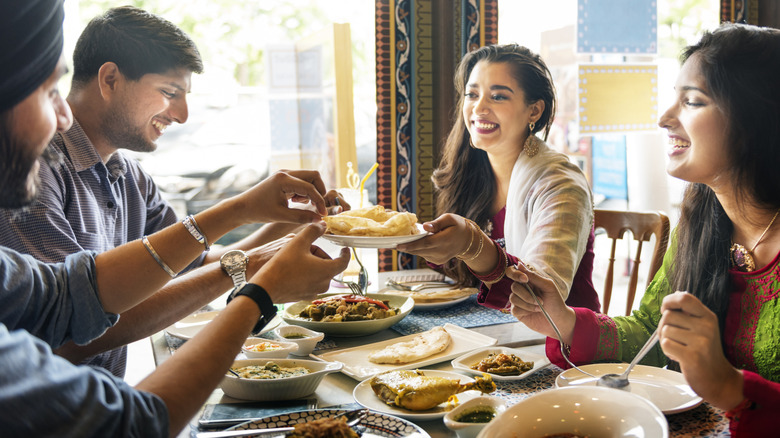
Unlike many other cuisines, a standout feature of Indian food is that every dish is meant to be shared. This is why you might have noticed that the portions you get at Indian restaurants are pretty big — usually enough for at least two people. And so, ordering individual portions for everyone at the table is the wrong move because you're ultimately over-ordering, and you'll be left with a lot more food than you can finish.
Aside from the large portions, Indian food is also meant to be shared by multiple people because that's the best way to savor the flavor of various dishes at a time. These dishes usually have complementary flavors and also nutritionally balance the meal. This is one of the reasons servers often suggest ordering two or three separate curries at once. Hence, it's also worth keeping this in mind the next time you visit an Indian restaurant and are thinking of ordering an entire dish for yourself.
If you're one of those people who doesn't like the idea of sharing food (some of us are like Joey from "Friends," and there's nothing wrong with that), the best bet is to order a thali. The whole concept of a thali is that it offers a balanced meal for one person, so you can try a number of dishes at once without having to share.
Not asking what to order with your main dish
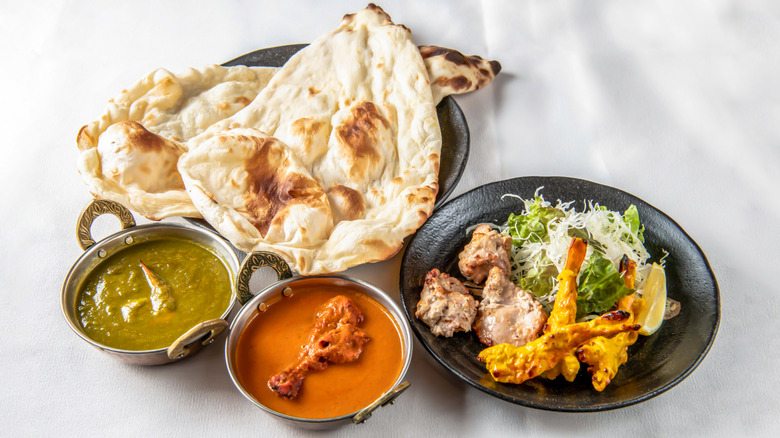
It's easy to think that naan is the ultimate accompaniment for any Indian main dish. But I'm here to burst that bubble and tell you that isn't the case. Sure, naan tastes great alongside many Indian curries, but it isn't meant to be eaten with every one of them, simply because it's a bread eaten in North India. So, it will technically taste the best only with North Indian mains like butter chicken, palak paneer, or dal makhani. When it comes to other curries, not asking the server what to order with them is a blunder because you might end up pairing foods that aren't traditionally eaten together.
You might think that isn't too big a deal, and I do somewhat agree. Honestly, if you eat lamb vindaloo with naan, it isn't going to taste odd. But at the same time, since this dish is from South Western India, it's traditionally eaten with roti, rice, or pav (soft Indian bread rolls). So, if you eat the lamb vindaloo with either of these accompaniments, imagine how much better it will taste.
Similarly, if you happen to be at a restaurant that serves both North and South Indian food, ordering a South Indian main with a North Indian accompaniment won't be the best idea, as that will actually create a weird combination. Presuming that odd flavor and texture combinations aren't something you're looking forward to, isn't it better to just take recommendations from the staff? I think so, too.
Not ordering raita, lassi, or buttermilk with your meal
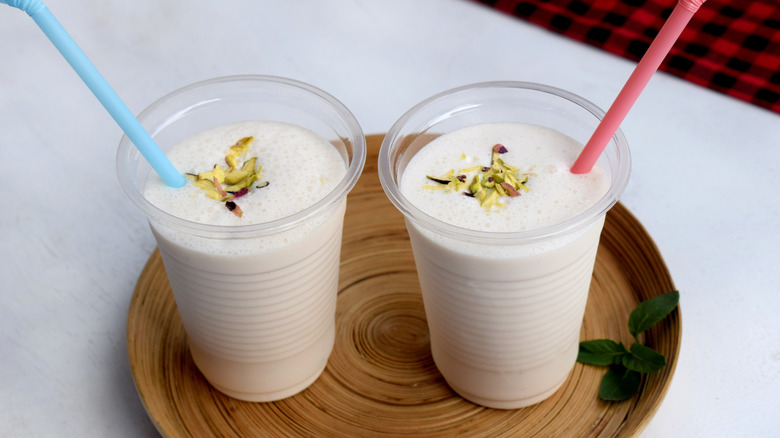
While a lot of people do enjoy having lassi at Indian restaurants, they generally order it after their meal as a dessert, which is understandable, given how sweet it is. The fact of the matter, though, is that the traditional way to enjoy lassi is along with your meal, because it's yogurt-based and also has a sweet flavor that can help you cool down when you're eating all that spicy food.
I get it, though — some of you might find the pairing of sweet lassi with spicy food pretty odd. In that case, I'd recommend ordering raita or buttermilk along with your meal because they serve the same purpose. Before you wonder how buttermilk can be a replacement for lassi, let me tell you that Indian-style buttermilk isn't the milk that's left after you churn butter out of heavy cream. This buttermilk is a yogurt-based beverage that's pretty similar to lassi, but instead of being sweet, it's mildly salty. It's also a little thinner than lassi, so it will be lighter on your stomach while cooling your palate down.
On a similar note, raita is a dip or accompaniment made by mixing yogurt with a few mild spices and veggies like cucumbers, onions, and tomatoes. A spoonful of raita goes perfectly with spicy curries, especially for those of you with a lower spice tolerance, and hence is worth ordering for a balanced meal.
Ordering a dessert for everyone at the table
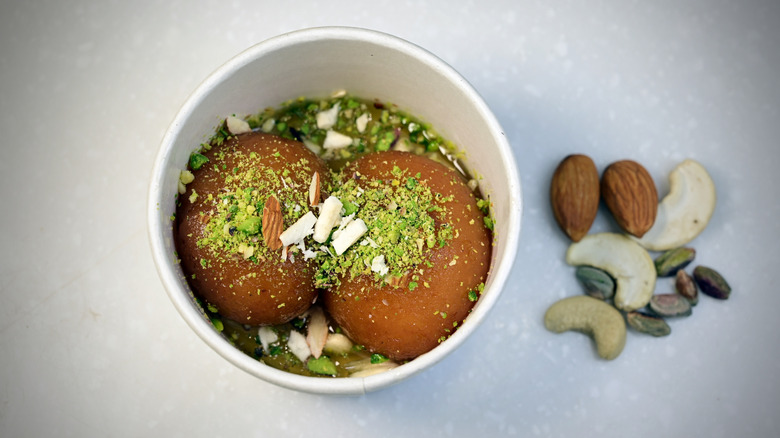
It may seem like a great idea to order a dessert for everyone at the table when dining at an Indian restaurant. I wouldn't recommend doing that, especially if you haven't tried many of these desserts before, because many are pretty rich. If you order a portion for everyone at the table after a heavy meal, it's very likely that some will go unfinished.
Many Indian sweets, like jalebi and gulab jamun, are very dairy-rich and are soaked in heaps of sugar syrup. So, they can be too sweet and a bit much for the palate if you aren't used to them. Some other Indian desserts are made primarily with nuts and sugar, and these, too, can be a lot for one person to finish. Not to mention that these sweets are extremely calorie-dense.
Unless you have a massive sweet tooth that can handle just about anything, I'd suggest ordering a dessert or two for the table, sharing those, and then ordering more only if you find the need to. Or you could speak to the server and ask for samples of each dessert, as some Indian restaurants do. If you're really hellbent on ordering a portion for everyone at the table, go for desserts that are a little lighter, like kheer or phirni, both of which are Indian versions of rice pudding. Of course, you can also ask the staff to recommend similar light sweets if you'd like something else.