

The Origins Of IKEA's Food Court Date Back To The 1950s
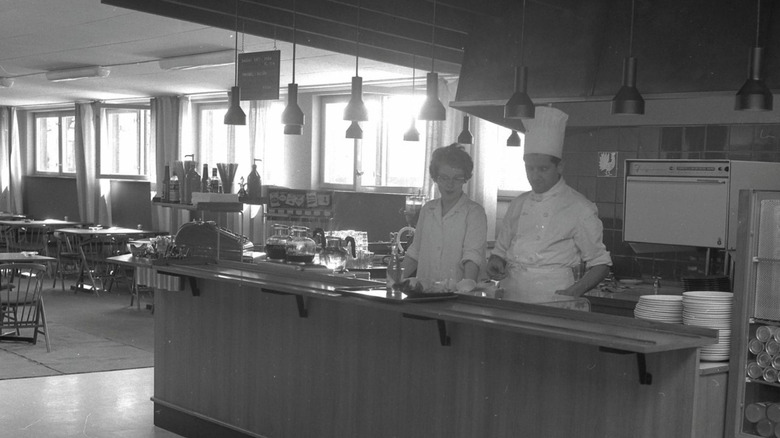
Modern IKEA is known worldwide for its affordable Swedish meatballs and European snacks, but what you probably don't know is that the retail giant has been mixing food and furniture ever since its original grand opening in 1953. The IKEA Museum website tells the story of its founder, Ingvar Kamprad, and his plan to serve "coffee and a biscuit" (cookie) to every visitor on the opening day of his first furniture showroom. While they only prepared around 200 servings to start with, almost 1,000 biscuits had been eaten by the end of the day, and it was much appreciated by the hungry visitors who had travelled so far to see the showroom.
Back then, Kamprad wasn't in a position to offer biscuits every day, but he did make sure to give his daily customers a glass of squash (a nonalcoholic fruit cordial mixed with water) as a sign of his appreciation. In 1958, after a few years of growing success, he opened his first IKEA-branded store and installed a restaurant in 1960. Because families from around Sweden were travelling to visit the store, Kamprad felt it was essential to offer food. If people were treating a visit to IKEA as a day trip, then they would need to eat, and if they couldn't do it at the store, they would have to leave and go somewhere else. This desire to express thanks to customers for their patronage has been the driving force behind the company's growing food courts ever since.
One of the biggest and most affordable restaurant chains in the world
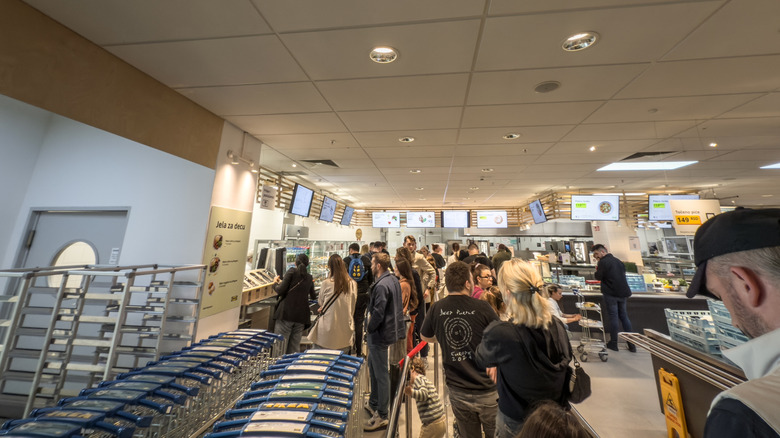
After a slight period of stagnation in the late 1970s, IKEA's food offerings really took off in the 1980s when it developed a coherent restaurant concept to use across all of its stores and developed its world-famous Swedish meatball recipe. Nowadays, it has grown to be one of the biggest restaurant chains in the world, serving people in the Americas, Europe, Africa, Asia, and Australia. But, despite the size, success, and making its food a central part of the business, IKEA's motivations remain surprisingly consistent with Kamprad's original vision. The company doesn't sell food to make a big profit on it — in fact, profit margins are strictly controlled with a sweet spot of 5% and a maximum of 10%. The business doesn't use food profits to survive, it uses food to encourage furniture sales — and that's why IKEA food is so amazingly affordable across the world.
For example, the average lunch for me in Copenhagen costs around 100 to 120 Danish kroner, but at IKEA, I can get a big plate of Swedish meatballs for just 49 kroner! And if you're okay with going meat-free, the plant balls are even cheaper at just 29 kroner. Food at IKEA isn't just a good deal; it's likely the best deal in the area, which is exactly what the company is aiming for.