

10 Of The Best Baking Hacks We Learned From The Great British Bake Off
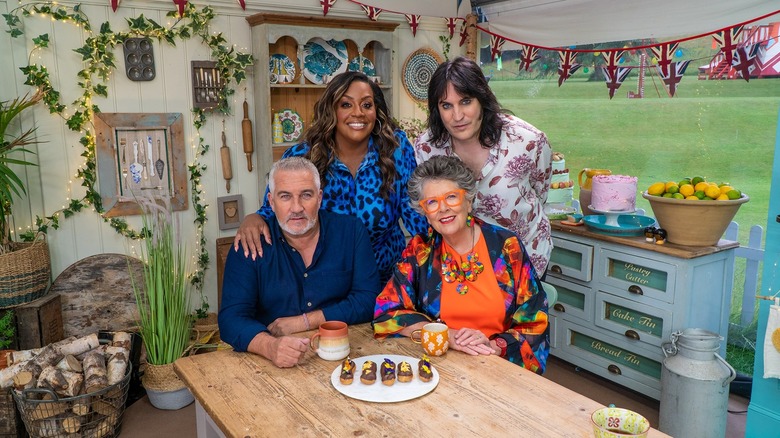
"The Great British Bake Off" ("GBBO") has become a worldwide cultural phenomenon. With 16 seasons spanning 15 years, multiple international spinoff shows, and 14 cookbooks by cast members of "The Great British Bake Off," this reality show has turned into quite the empire. The series is quintessentially British, delighting viewers with its mix of wholesome charm, dry humor, and playful challenges that put amateur bakers to the test.
Because its contestants are home bakers, "GBBO" is no stranger to the occasional kitchen disaster. Those mishaps can often create some of the best and most memorable moments of the show, when the wise and experienced chef judges, Mary Berry, Paul Hollywood, and Prue Leith, offer their valuable insights into technique and presentation for both contestants and viewers. Many home bakers even come to the show with a few odd tricks of their own up their sleeve. So whether you're an experienced baker or just starting out, there's something to learn from the "The Great British Bake Off" show. Some of these unusual hacks may even surprise you.
Blind bake your pastry to avoid a soggy bottom
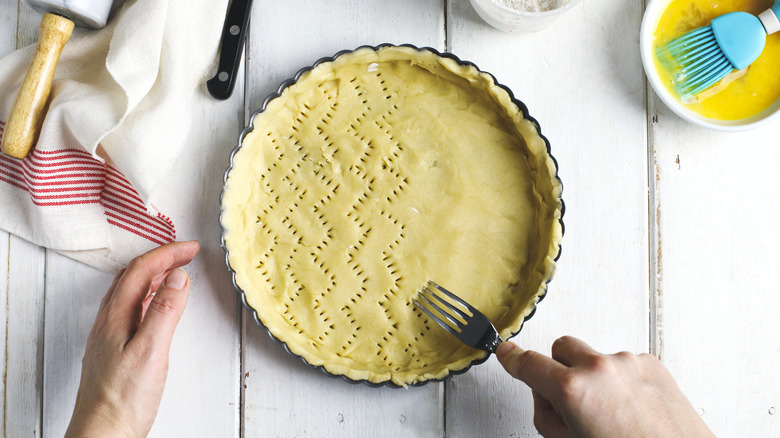
If you're a fan of "The Great British Bake Off," you know the phrase "soggy bottom" is practically the show's catchphrase. A wet pastry base can ruin even the most beautiful tart, and the judges never let it slide. But not to worry — they've also offered a wealth of advice to contestants and viewers on this topic. The judges all recommend blind baking your pastry crust to avoid the dreaded soggy bottom. Blind baking is essentially pre-baking your pie crust to give it more structure before you add your filling.
For the first step of pressing your dough into the tin, Mary Berry suggests using a small piece of leftover pastry to press your dough into the tin, ensuring an even layer without tearing. Then, Paul Hollywood recommends adding weights atop the pastry to keep the crust from bubbling up during baking. There are ceramic weights sold for this specific purpose, but our beloved judge has a personal favorite alternative: dried mung beans.
Before you move on to adding your filling, Prue Leith recommends another layer of insurance: Sprinkle a little semolina on the pastry to absorb excess moisture. These steps might add to the time it takes to bake your treats, but they can make all the difference in a pastry that holds its shape versus one that falls apart.
Use strips of parchment for an easy release of tarts or muffins
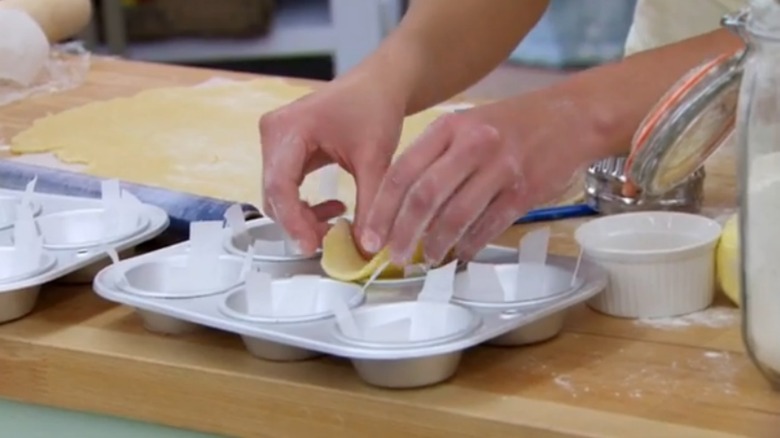
When the tent turns to tiny pies, you'll sometimes catch a clever move: Two parchment strips crossed in the cup before the dough goes in. Fan favorite baker Ruby Tandoh did exactly that in Season 4, Episode 4, laying paper "tabs" under her mini pies so she could lift them straight out without worry. This technique is a simple insurance policy against sticking, crumbling edges, or torn crusts when you're working in a muffin tin.
Baking pros call this a "parchment paper sling." You'll need two 1-inch parchment paper strips, crisscrossed so the ends hang over the rim of your pan like handles. You can even use metal binder clips to keep parchment paper in place while filling, and prevent it from shifting as you work. Once your treat is baked, let it cool a few minutes, then lift cleanly by the tabs. This technique can also be useful when baking with square and loaf pans, as the overhangs help you to remove delicate bars or quick breads without flipping and risking cracks.
Use a plastic water bottle to easily separate yolks from eggs
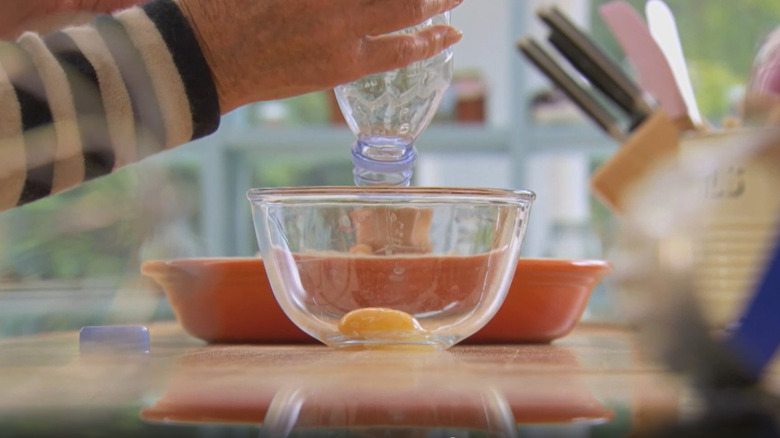
Separating egg yolks from egg whites can be a time-consuming and tedious task for bakers. Yet, it's a necessary evil for custards, meringues, and light fluffy cakes, all treats we frequently see fluster contestants on the time-sensitive "The Great British Bake Off" challenges. Luckily, judge Mary Berry has a clever trick for speeding up the process, and you only need a common household item: a plastic water bottle.
Simply crack your eggs into a bowl, gently squeeze an empty plastic bottle, then release over the yolk to create a rush of air that will suction up the fat-rich yolk and leave the whites behind. Then, over a separate bowl, give the bottle a light squeeze again to pop the yolk back out — it's as simple as that. Unlike traditional methods of separating egg yolks from whites, you won't risk shells breaking off into your egg and you're less likely to break the yolk, if you follow Berry's advice. She recommends releasing the bottle pressure slowly to avoid rupturing the fragile egg yolk.
Listen to your cakes to hear if they're underbaked
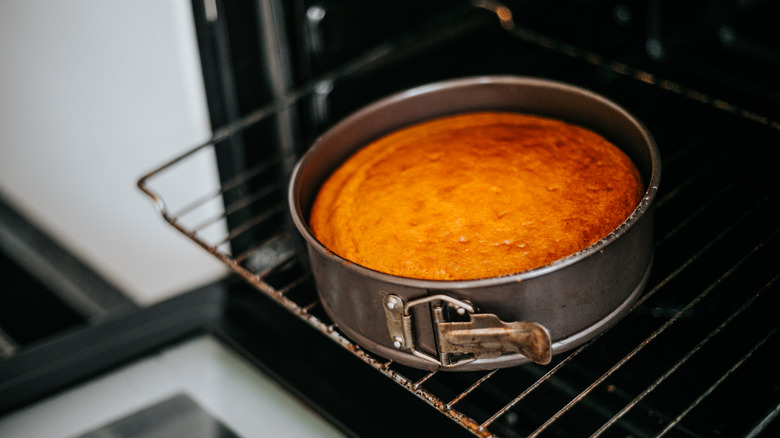
Cake baking is a tricky art, as contestants and viewers of "GBBO" know well. If you overbake your sponge, it could become dry and crumbly. Underbake it, however, and you're serving up raw batter, presenting a possible health risk to those who eat it.
One of the most popular ways to check on your cake's internal temperature is to pierce it with a toothpick or knife, but the method is unreliable and risks damaging your cake. Luckily, Season 3 "GBBO" winner John Waite has shared a unique way to check if your cake is done without a toothpick. In a trick he says he learned from his mother, Waite pulls his cake out and leans in close to have a listen. If there's the faintest hissing, bubbling, or crackling noise, it's headed back in the oven. Silence indicates it's fully cooked.
This method works because as your cake sets in the oven, water is evaporating from the batter. That vapor gives off a faint sound as it leaves the cake, so the absence of it is a good indicator that there's very little moisture left and you might be on the precipice of a dry sponge. Pair this with visual cues, like golden edges and a springy top, and you can start to develop your very own baker's intuition for the perfect cake.
Use a jar and a rubber band to easily fill a piping bag
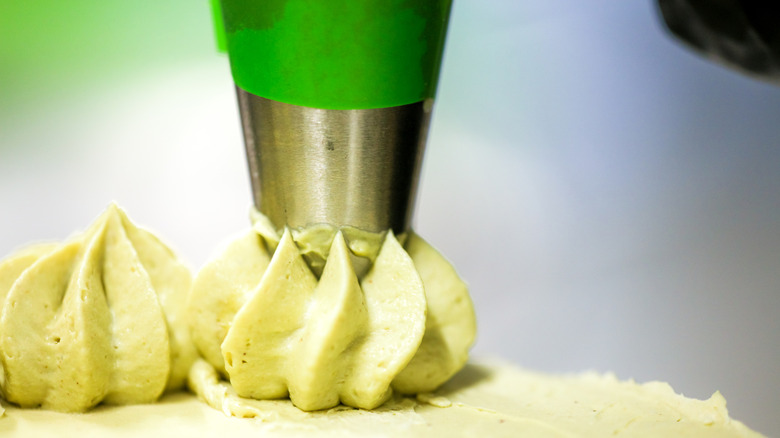
If you've ever tried to fill a piping bag one-handed, you know the struggle. For the inexperienced, that struggle often ends with icing all over the workspace — and very little in the bag. Season 11 winner Peter Sawkins offered a genius fix involving items you probably already have in your kitchen: a mason jar (or tall glass) and a rubber band.
Simply place the bag inside a tall jar or glass, fold the top cuff over the rim, and secure it with a rubber band. This creates a stable opening and holds the bag steady so you can scoop in frosting with both hands and avoid excess cleanup. Once the bag is filled, just remove the band, twist the top, and you're ready to pipe. As an additional step, you can push all your icing down or give the bag a twirl to minimize air pockets, which can cause uneven piping or sudden bursts.
The French Slap or slap and fold method for quickly kneading wet dough
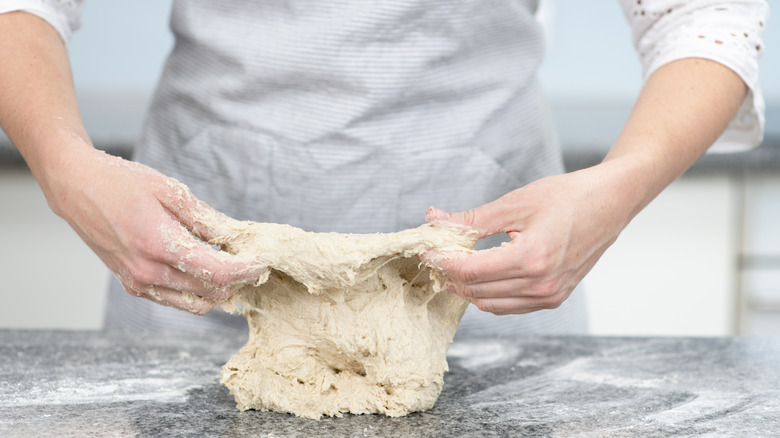
Sometimes, bakers employ techniques in the "GBBO" that turn heads of their fellow contestants and judges. That was certainly the case when German baker Jürgen Krauss began slapping his dough against his workspace in Season 12, episode five, referring to it as the "French slap." While the method is dramatic (and loud, in Krauss's case), it's actually a useful technique for quickly kneading dough that's more on the wet side.
More commonly known as the slap and fold technique, this trick can help you avoid the constant sticking of wet dough to your fingers and counter and speed up the laborious process of building the gluten. The key is momentum: Grab your dough from one end, give it a swing to let gravity stretch it, then slap the bottom onto the counter and quickly fold the top over. After about five to 10 minutes, your dough will gradually tighten and smooth out. This technique is great because you avoid adding excess flour in the kneading process that will dry it out, preserving the hydration of your dough for a lighter, airier bread.
Fan your cake with your baking pan to help it cool faster
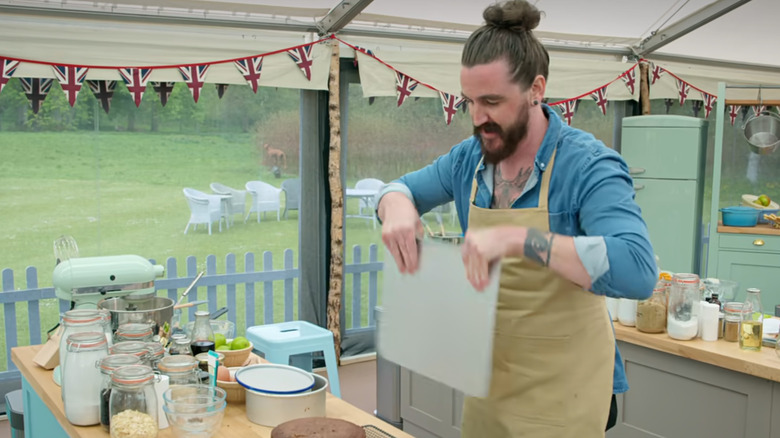
If you've watched enough "The Great British Bake Off," you've almost certainly seen bakers waving sheet pans over their cakes after taking them out of the oven. The sight is so synonymous with the franchise that in Season 10, episode one when Dan Chambers attempted to cool down his cake using the technique, fellow contestant Michael Chakraverty exclaimed, "He's doing the thing!"
The fanned frantic flapping adds to the chaotic energy of the room in those final moments in time-crunch challenges — but it turns out there's science behind it. Similar to blowing on hot soup to cool it down, moving the air above your cake can cool the surface by convection and accelerate the evaporation of excess liquids. In an environment like the "GBBO" tent, every minute counts, especially before frosting a sponge that could melt buttercream if it's too warm.
The trick works best when the cake is out of its tin and on a rack, so air can circulate on all sides. While fanning won't chill a cake instantly, it can shave off several minutes. Just be careful not to overdo it; too much airflow can dry out the surface. For home bakers, patience (or a fridge) is still the safest route, but if you're down to the wire preparing a cake, this can save you a few minutes and a melted icing mess.
Check if your dough is ready with the windowpane test
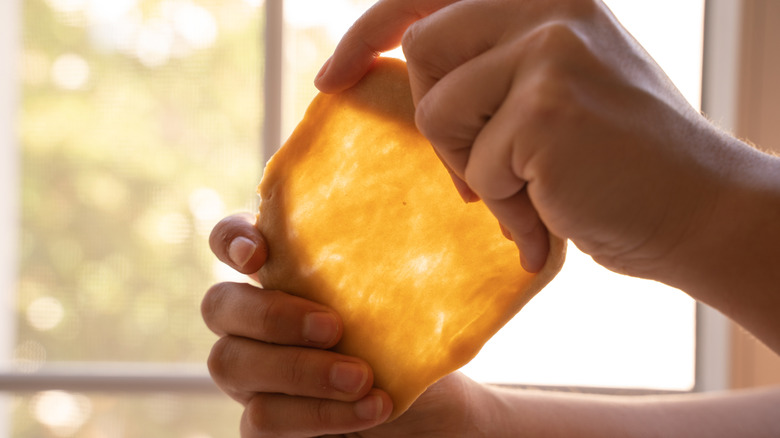
Bread week on "GBBO" often brings out this time-tested technique. The windowpane test is an easy way to know whether your bread is fully kneaded, taking the guesswork out of testing your gluten development. The idea is that your dough needs to have a fairly strong gluten network in order to support its rise during proofing. Otherwise, you could end of with a flat puck for a loaf.
To try the windowpane test, pinch off a small piece of dough and gently stretch it between your fingers. If it forms a thin, translucent "window" without tearing, your dough is ready to proof. If it rips easily, keep kneading.
Contestants like Martha Collison in Season 5 and Tom Gilliford in Season 7 have relied on this test to avoid dense loaves. It's especially useful for enriched doughs, which can feel soft even when properly kneaded. Just remember to rest the dough briefly before testing — stretching too soon can give a false fail.
In a pinch, microwave your dough to quickly proof it
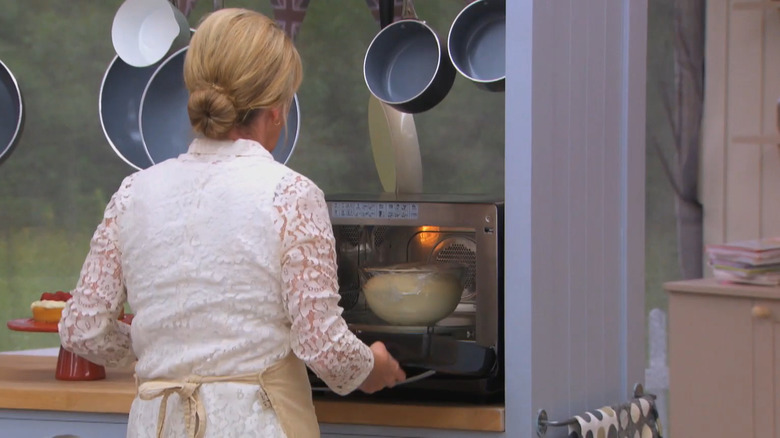
When time is tight, our "GBBO" bakers sometimes have to get creative. In Season 5, future winner Nancy Birtwhistle used a microwave to speed up proofing — a risky move that worked in her favor. Dough proofing can take hours, and bakers don't always have that kind of time. The key to this trick is to keep the microwave on a low setting, cover your dough, and place a cup of water in the microwave with your dough.
The waves will primarily heat the water, building up steam inside the closed microwave. After heating for two to three minutes, leave the door closed and let your dough sit for the rest of your proofing time. Dough loves to rise in a warm, moist environment, so this is the perfect way to cut down on the wait.
It's important not to overdo it, or you could kill your yeast. Make sure your heat level isn't too high, and microwave in short bursts. Save this method only for when you're truly in a time crunch.
Coat fruit in flour before including it in cakes to avoid sinking
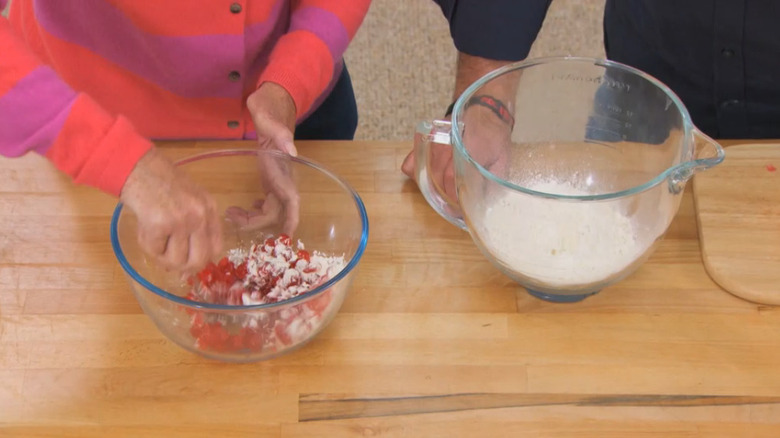
Few technical challenges have stumped "GBBO" bakers like Mary Berry's cherry cake in Season 5. Like most technical challenges on the show, the instructions were vague with only a few steps. On top of that, the pressure was on to impress a judge with her own recipe. Unfortunately for many of the bakers, their cherries released moisture, making their cake wet and causing the dense cherries to sink to the bottom.
Sinking is a common problem for adding not just cherries, but any fruit, to a cake. Luckily for us, Mary Berry herself divulged her secret. She shared that her preferred method is to chop the cherries into quarters, pat them dry, and toss them in flour before folding them into the batter.
This technique is key because the flour creates a light coating that helps the fruit cling to the batter and retain some of its moisture, instead of releasing all its water and sliding to the bottom during baking. Just don't overdo the flour, or you might create dry clumps in your cake. Just a light coat is enough to do the trick.