

19 Crops That Would Disappear Without Bees
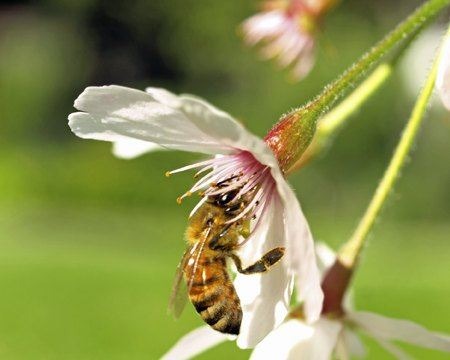
Bees have been disappearing at an alarming rate and continue to vanish without a trace.
Why should anyone care? Well, they matter a lot more than most people would think. With summer upon us, it's exciting to see the reemergence of some of our favorite produce, including stone fruit, peppers, sweet, juicy melons, and succulent strawberries. But what if the arrival of these crops each summer were to come to an end?
Click here to see the 19 Crops That Would Disappear Without Bees Slideshow
Honeybees, among other pollinators such as bats, birds, butterflies, and bumblebees, are responsible in one way or another for the pollination of approximately 100 crops, according to Dr. Reese Halter, Ph.D., author of The Incomparable Honeybee and distinguished conservation biologist. And they're not just the fruits of summer; imagine a Thanksgiving, for example, without sweet potatoes or pumpkin pie.
However, the implications of the disappearance of honeybees are not just gastronomic; they are also economic in scope, and in that respect, the scale is significant. According to the National Resources Defense Council (NRDC), more than $15 billion worth of crops are pollinated by bees each year just in the United States alone. Put another way, one of every three bites of food Americans consume comes from a plant visited by bees or other pollinators.
The problem was first observed in France in 1994, following the debut of a new type of pesticide by Bayer, dubbed Gaucho, which was first used on sunflower crops. Gaucho was part of a new class of pesticides known as systemic pesticides, or as Halter refers to them, neonicotinoids.
Bees collecting pollen from sunflowers treated with Gaucho exhibited confused and nervous behavior; thus, the phenomenon was initially termed the "mad bee disease" — the bees, according to Halter, were literally "shaking to death." Furthermore, the bees abandoned their hives, never to return, leaving only the queen behind. Following massive protests by farmers, the French government suspended the use of the pesticide.
In the United States, the phenomenon was first observed in 2006 by a beekeeper, David Hackenberg. Hackenberg and his fellow beekeeper David Mendes testified before Congress about a problem that had become widespread, by then termed Colony Collapse Disorder (CCD) by scientists. No longer were people chalking it up to bad beekeeping; everyone was experiencing the same rapid, catastrophic declines in hive populations in 35 states. And no one could explain why.
The theories were numerous, but the data were scarce. Some people thought that cellphone towers were interfering with the bees' ability to navigate; others thought that the bees were falling prey to the usual suspects, including the varroa mite and the fungal bacteria nocema ceranae; while another popular theory was climate change. But, no one really knew for sure, because CCD very rarely left behind any dead bees in the broken hive that could be examined.
The most compelling theory, though, has to do with bee husbandry, and brings us full circle back to the issue of systemic pesticides. Beekeepers in the United States no longer generate the majority of their revenue from sales of honey; the value of honey sold annually in the United States amounts only to $150 million a year, according to the NRDC, a mere fraction of the value of the crops pollinated by bees.
The life of a typical bee in this business consists of following the major cash crops around the country as the seasons change, and that means a lot of traveling on trucks. California alone requires half of all the honeybees in the United States for its $2.3 billion almond crop annually, according to the NRDC.
So stress is probably a major issue, but far more relevant is the fact that while on the road, there is no access to local flora to collect nectar for honey. So instead, according to Halter, they subsist on a steady diet of corn syrup, usually genetically modified and laden with residual neonicotinoids. Halter estimates that about 2.5 million hives are trucked around this manner every year.
Just what is so insidious about neonicotinoids? Neonicotinoids differ from older style pesticides which were applied through spraying; instead, they generally come in the form of pellets, which are taken up by the roots of the plant when watered, and end up concentrated in the pollen and nectar that bees pick up when foraging. But, it doesn't end there. Subsequent generations of the plant will also contain trace amounts of the pesticide and secrete them as well.
Studies performed by companies which produce these neonicotinoids have tested only in lethal doses and observed the bees immediately after exposure. But, in the real world, bees are never really exposed to such high concentrations all at once. Instead, the concern lies with the accumulated effects of repeated exposure in lower concentrations, which are difficult to test, and thus have not been tested. In other words, the use of these systemic pesticides could lead to a delayed detrimental effect on bee populations.
However compelling any one theory may be, it is more likely though, that CCD is due to a confluence of factors.
Halter estimates that about one-quarter trillion bees have succumbed to CCD since it was first observed in France in 1994. And it is an ongoing problem. Halter says that prior to CCD, beekeepers would normally observe natural attrition rates of 11 to 12 percent. Nowadays, it is common to lose upward of 30 percent of the hive during transport.
Policymakers are beginning to act, however. In Europe, Halter says that neonicotinoids are starting to be banned. And the NRDC successfully sued the EPA in New York State in December 2009 over the questionable approval of a new systemic pesticide. Sales were halted nationwide in January 2010 pending further investigation. Similar actions will help bee populations from declining further.
Here are a few things you can do, however, to combat the problem.
1. Buy Organic. Buying organic fruits and vegetables keeps more pesticides from being introduced into the environment and helps encourage more sustainable farming practices that are beneficial to bees.
2. Buy Local. Shop at farmers markets when seasons allow to support smaller-scale farms that are less likely to engage in monoculture. When the choice is between imported, certified organic produce and local, non-certified produce, choose local first; chances are, smaller-scale farmers are already engaging in practices that comply or exceed the requirements of organic farming, but choose not to get certified due to high costs and other pragmatic barriers.
3. Host a Hive. Urban beekeeping provides a safe refuge for honeybees and in return, they help cross-pollinate the local flora. In 2010, New York City lifted the ban on urban beekeeping, following similar actions by Seattle, San Francisco, and Chicago, and since then, it has become quite popular among city residents. Most recently, the Waldorf-Astoria Hotel has set up a beekeeping operation on its roof to harvest honey. And they're not the only ones to jump onto the beekeeping bandwagon; hotels around the world have started providing homes for bees as well.
We're serious folks — the foods that make America great are at stake here. Not just fancy-schmancy chef food, but all-time greats like cranberry sauce, peach cobbler, and apple pie. And the continued decline in bee populations would lead to the continued increase in world food prices.
To see all the recipes that you'd miss, click here to see the 19 Crops That Would Disappear Without Bees Slideshow.
Will Budiaman is the Recipe Editor at The Daily Meal. Follow him on Twitter @WillBudiaman.