

10 Tips For Making The Perfect Burger
"To me, traditional burgers are made with chuck meat, either rump steak or shoulder meat from the front. You don't want to make a hamburger from filet mignon. One, it's a waste of meat, and two, it doesn't really taste that good." Waxman recommends a ratio of 75:25 or 80:20 explaining that 90:10 is too lean and anything less than 75 is too fatty. Another tip? Make sure that when the butcher grinds the meat that everything is super cold: the grinder, the environment, and the meat, otherwise the fat gets all messed up and you're left with a lugubrious mass.
Tip #2: The Art of Simple Seasoning
Keep it simple. While people like to add a lot of things to the meat like diced onions, vegetables, cheese, eggs, etc., Waxman likes to stick to basics. He doesn't have a problem with adding those things, but "it's kind of like you're making a grilled meatloaf, so let's call a spade a spade." For his burgers, he says to use sea salt, not kosher or table, but good quality, coarse salt, fresh pepper, and meat. That's it. Otherwise, you're just trying too hard.
Tip #3: The Patty
"A perfect burger is between six to seven ounces, if it gets too big, then you're just being silly." The other problem Waxman mentions is over-handling your meat because that's when meat gets tough. After it's ground, literally just push it together in a patty, weigh it in the raw state, making it about an inch thick in the center — that's perfect. He says that the outside can be a little skinner, but "you don't want it to be a blob."
Also, make sure the patty is nice and round, "not square, trying to put meat in a square shape is just crazy, I don't understand that," he says. Overall, it's just important to respect the meat and get the fire and everything else in order.
Tip #4: Cheese Type & the Perfect Melting Method
What does Waxman like on his burger? "Gruyère, Cheddar, Monterey Jack with jalapeño, simple stuff, but I don't like blue cheese burgers. Some people do, I just don't," he says. Here's how you cook it properly though. If you have a grill with a cover, grill on one side, three quarters of the way, flip it over, and immediately put the cheese on top. Then cover the grill so the bottom gets cooked and the cheese melts perfectly. "I like cheese that's grated versus a slab because it melts better. You can always put a clump of grated cheese on top of the middle of the burger so it melts out, otherwise a slab will just melt out and over the burger onto the grill."
Tip #5: To Top or Not to Top
"To each your own for toppings, but I like grilled mushrooms. Porcinis are the best, thinly sliced and not too thick." For some creativity and California flavor, Waxman loves putting guacamole on burgers. He also loves adding aioli, but not too much.
Tip #6: The Perfect Buttered Bun
"I love toasting my bun, so it can soak up the sauce, but I don't like it soft." Waxman's trick? "Buttering the bun after I grill it, not too much, but just a little. People are always like, 'what's that flavor?'"
Tip #7: Griddle vs. Grill
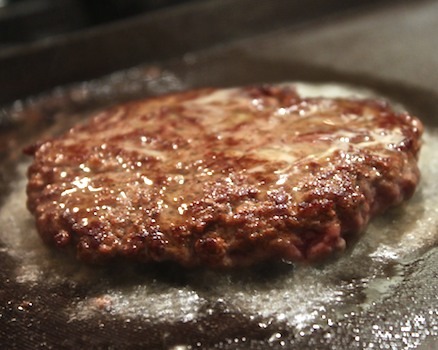
The debate and ultimate outcome according to Waxman: "Burgers are a funny thing, when I was a kid, on at least on the West Coast, they were always cooked on the grill, unless you were at a diner, then they were cooked on a griddle to death. On the East Coast though, there's a lot of controversy over griddle versus grill. There are a lot of good things about the griddle, but you don't get the smoke, the char effect, or flavor from the grill. You could actually put a griddle on a BBQ, that's kind of the Australian method. They cook over an open fire and put a griddle on top. It's kind of cool because you can do both. And honestly, it's a lot less messy.
But if you do barbecue and get the heat right, then it can be perfect. The problem with a lot of barbecues is that the grills themselves are too skinny and not like professional ones, which are a quarter inch by a quarter inch. Some grills are too skinny like a wire and that's a difficult medium to cook on. So I'd say try to get a more professional-style grill as a first step. I hate gas, it's only wood or charcoal for me. But that's a more iffy proposition for people..."
Tip #8: Seasoning the Grill
Make sure the grill is seasoned properly. Waxman recommends grilling up some bacon first so all the delicious flavor gets on the grill, then cooking the burger, and topping it with the cooked bacon. (Sounds like one of the greatest ideas we've heard in a long time.)
Tip #9: How Hot Is Too Hot?
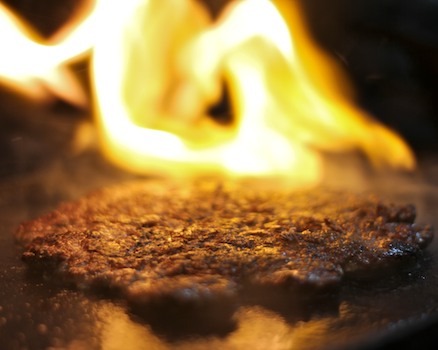
Griddle or grill, how do you know when it's hot enough? "Medium heat is ideal: Not too low, and not too high." Waxman says that for all grilling mediums, it should be the same, but it's relative to the type of grill that you're using. If the grill is open-style, which means that the heat goes vertically straight up, then the burger doesn't get the residual heat, and you are just cooking from the bottom up. This technique takes a lot of skill, Waxman explains. But if you use a grill with a lid, you can close the grill and capture the heat to give you more control and more smokiness. Also it allows you to play with the temperature more. But he does say that neither is better than the other for cooking burgers, you just need to understand what you're doing. One thing he recommends though is going the extra mile to use hardwood charcoal, not briquettes.
Tip #10: Take Your Time
"Everyone tries to cook too many burgers at the same time, so I tell them to chill out, have a beer or glass of wine, and then when the burgers ready, you'll have a great burger." That's why they call Waxman the Obi Wan Kenobi of the kitchen.
Click here to see the Best Burger recipe.
Click here to see the Ultimate Sriracha Burger recipe.